Recommendations from the scientific community to ensure that the development and use of AI honors scientific norms
In late 2022, OpenAI released ChatGPT, an AI chatbot capable of generating conversational answers and analyses, as well as images, in response to user questions and prompts. This generative AI is built with computational procedures, such as large language models, that train on vast bodies of human-created and curated data, including huge amounts of scientific literature. Since then, the worry that AI may someday outsmart humans has only grown more widespread.
In the past, as society grappled with the implications of new technologies—ranging from nuclear energy to recombinant DNA—the scientific community developed practices designed to increase adherence to the norms that have protected the integrity of each new form of scientific exploration, development, and deployment. In the process, scientists expanded their community's repertoire of mechanisms designed to advance emerging science and technology while safeguarding the integrity of science and the wellbeing of the nation and its people.
This book provides a historical perspective on and an ethical approach to emerging AI technologies; an overview of AI frameworks and principles; and an assessment of AI's current advances, hurdles, and potential. Experts from the fields of behavioral and social sciences, ethics, biology, physics, chemistry, mathematics, and computer science, as well as leaders in higher education, law, governance, and science publishing and communication, comprise the book's contributors. Their essays remind us that, even as our understandings of emerging technologies and of their implications evolve, science's commitment to core norms and values remains steadfast. The volume's conclusion advocates for following principles of human accountability and responsibility when using artificial intelligence in research, including transparent disclosure and attribution; verification and documentation of AI-generated data and analysis; a focus on ethics and equity; and continuous oversight and public engagement.
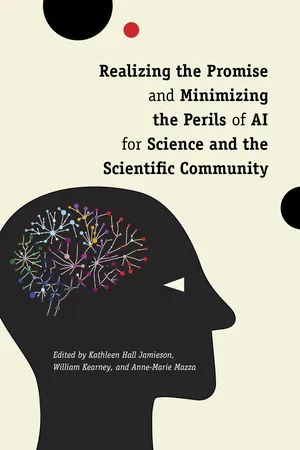
eBook - ePub
Realizing the Promise and Minimizing the Perils of AI for Science and the Scientific Community
- 288 pages
- English
- ePUB (mobile friendly)
- Available on iOS & Android
eBook - ePub
Realizing the Promise and Minimizing the Perils of AI for Science and the Scientific Community
About this book
Information
Table of contents
- Cover
- Title Page
- Copyright
- Contents
- 1. Overview and Context
- 2. The Value and Limits of Statements from the Scientific Community: Human Genome Editing as a Case Study
- 3. Science in the Context of AI
- 4. We’ve Been Here Before: Historical Precedents for Managing Artificial Intelligence
- 5. Navigating AI Governance as a Normative Field: Norms, Patterns, and Dynamics
- 6. Challenges to Evaluating Emerging Technologies and the Need for a Justice-Led Approach to Shaping Innovation
- 7. Bringing Power In: Rethinking Equity Solutions for AI
- 8. Scientific Progress in Artificial Intelligence: History, Status, and Futures
- 9. Perspectives on AI from Across the Disciplines
- 10. Protecting Scientific Integrity in an Age of Generative AI
- 11. Safeguarding the Norms and Values of Science in the Age of Generative AI
- Appendix 1. List of Retreatants
- Appendix 2. Biographies of Framework Authors, Paper Authors, and Editors
- Index
Trusted by 375,005 students
Access to over 1.5 million titles for a fair monthly price.
Study more efficiently using our study tools.
Frequently asked questions
Yes, you can cancel anytime from the Subscription tab in your account settings on the Perlego website. Your subscription will stay active until the end of your current billing period. Learn how to cancel your subscription
No, books cannot be downloaded as external files, such as PDFs, for use outside of Perlego. However, you can download books within the Perlego app for offline reading on mobile or tablet. Learn how to download books offline
Perlego offers two plans: Essential and Complete
- Essential is ideal for learners and professionals who enjoy exploring a wide range of subjects. Access the Essential Library with 800,000+ trusted titles and best-sellers across business, personal growth, and the humanities. Includes unlimited reading time and Standard Read Aloud voice.
- Complete: Perfect for advanced learners and researchers needing full, unrestricted access. Unlock 1.5M+ books across hundreds of subjects, including academic and specialized titles. The Complete Plan also includes advanced features like Premium Read Aloud and Research Assistant.
We are an online textbook subscription service, where you can get access to an entire online library for less than the price of a single book per month. With over 1.5 million books across 990+ topics, we’ve got you covered! Learn about our mission
Look out for the read-aloud symbol on your next book to see if you can listen to it. The read-aloud tool reads text aloud for you, highlighting the text as it is being read. You can pause it, speed it up and slow it down. Learn more about Read Aloud
Yes! You can use the Perlego app on both iOS and Android devices to read anytime, anywhere — even offline. Perfect for commutes or when you’re on the go.
Please note we cannot support devices running on iOS 13 and Android 7 or earlier. Learn more about using the app
Please note we cannot support devices running on iOS 13 and Android 7 or earlier. Learn more about using the app
Yes, you can access Realizing the Promise and Minimizing the Perils of AI for Science and the Scientific Community by Kathleen Hall Jamieson,Bill Kearney,Anne-Marie Mazza,William Kearney in PDF and/or ePUB format, as well as other popular books in Politics & International Relations & Artificial Intelligence (AI) & Semantics. We have over 1.5 million books available in our catalogue for you to explore.