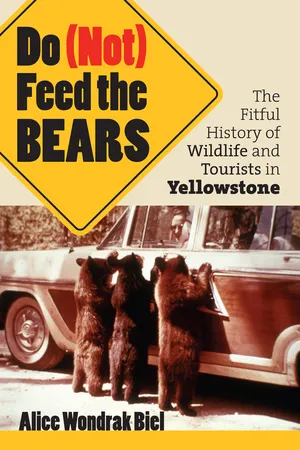
It was a familiar sight at Yellowstone National Park: traffic backed up for miles as visitors fed bears from their cars. It may have been against the rules, but park officials were willing to turn a blind eye if it kept the public happy. But bear feeding eventually became too widespread and dangerous to everyone—including the bears—for the National Park Service (NPS) to allow it any longer.
As one of the park’s most beloved and enduring symbols, the Yellowstone bears have long been a flashpoint for controversy. Alice Wondrak Biel traces the evolution of their complex relationship with humans—from the creation of the first staged wildlife viewing areas to the present—and situates that relationship within the broader context of American cultural history. Early on, park bears were largely thought of as performers or surrogate pets and were routinely fed handouts from cars, as well as hotel garbage dumped at park-sanctioned “lunch counters for bears.” But as these activities led to ever-greater numbers of tourist injuries, and of bears killed as a result, and as ideas about conservation and the NPS mission changed, the agency refashioned the bear's image from cute circus performer to dangerous wild animal and, eventually, to keystone inhabitant of a fragile ecosystem.
Drawing on the history of recorded interactions with bears and providing telling photographs depicting the evolving bear-human relationship, Biel traces the reaction of park visitors to the NPS’s efforts—from warnings by Yogi Bear (which few tourists took seriously) to the increasing promotion of key ecological issues and concerns. Ultimately, as the rules were enforced and tourist behavior dramatically shifted, the bears returned to a more natural state of existence.
Biel’s entertaining and informative account tracks this gradual “renaturalization” while also providing a cautionary tale about the need for careful negotiation at the complex nexus of tourists, bears, and all things wild.