"Who's Gonna Water My Tomatoes?": School Gardens, Kitchens, and the Search for Educational Authenticity updates an old concept for our modern age, utilizing school gardens and culinary kitchens where students grow, prepare, and eat their own food.
Over a century ago, the educational philosopher John Dewey proposed reforming education around the needs of the whole child, emphasizing academic learning and the child's social needs for effective participation in a democratic society. In Dewey's view, children would best learn by engaging in authentic experiences that would introduce, complement, and complete their regular classroom experiences. Dewey talked about school gardens and kitchens as two specific laboratories where children could apply what they were learning in school in daily life. Today, the tensions between experiential learning and the more rote learning often found in regular classrooms remain. Educators increasingly find themselves accountable to the narrow performance pressures imposed by standardized testing, pressures that often squeeze out the joys and possibilities for more authentic and engaging learning found in real-world experiences.
This book explores Dewey's philosophy with particular attention given to experiential learning's relationship to gardens and kitchens. The school garden and kitchen movement itself has ebbed and flowed over the last hundred years in response to changing societal and educational pressures. This history leads to the present day, where the edible schoolyard movement is experiencing a new spring as educators, parents, and school communities find value in edible schoolyard's possibilities for providing more wholistic education that better meets the academic, social, and emotional needs of students. The book focuses on a network of edible schoolyards by introducing educators, teachers, principals, and staff who are making edible schoolyards happen today. Their vision and motivations form in their favorite lessons and in the connections between garden and kitchen experiences to the more traditional subject matter favored on state tests. Suggestions and resources for starting new edible schoolyards, including suggested recipes, are provided for those who want to get growing with their own edible schoolyards.
Perfect for courses such as: Educational Reform; Educational History; Educational Philosophy; Educational Leadership; Curriculum Development and Transformation; Experiential Learning; Project Based Learning; and Educational Policy Environments
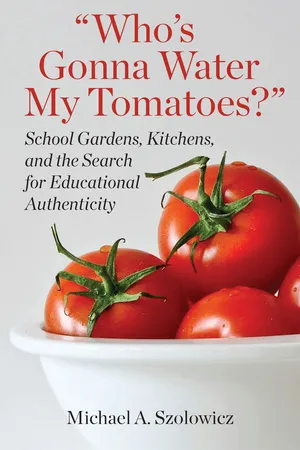
eBook - ePub
Who’s Gonna Water My Tomatoes?
School Gardens, Kitchens, and the Search for Educational Authenticity
- 200 pages
- English
- ePUB (mobile friendly)
- Available on iOS & Android
eBook - ePub
Who’s Gonna Water My Tomatoes?
School Gardens, Kitchens, and the Search for Educational Authenticity
About this book
Information
Table of contents
- Cover Page
- Title Page
- Copyright Page
- Table of Contents
- List of Tables
- Acknowledgments
- Foreword
- Chapter 1. Introduction
- Chapter 2. Engaging Education in an Age of Standardization
- Chapter 3. Edible Schoolyards Yesterday and Today
- Chapter 4. Self-Determination Theory and Edible Schoolyards
- Chapter 5. Leadership for Edible Schoolyards
- Chapter 6. Favorite Projects for Learning
- Chapter 7. Breaking Down the Walls Between Edible Schoolyards and Classrooms
- Chapter 8. Starting an Edible Schoolyard
- Chapter 9. Conclusion
- Appendix A: Garden Lesson
- Appendix B: Kitchen Lesson
- Appendix C: Recipes
- Appendix D: Resources
- Author Biography
- Index
Trusted by 375,005 students
Access to over 1.5 million titles for a fair monthly price.
Study more efficiently using our study tools.
Frequently asked questions
Yes, you can cancel anytime from the Subscription tab in your account settings on the Perlego website. Your subscription will stay active until the end of your current billing period. Learn how to cancel your subscription
No, books cannot be downloaded as external files, such as PDFs, for use outside of Perlego. However, you can download books within the Perlego app for offline reading on mobile or tablet. Learn how to download books offline
Perlego offers two plans: Essential and Complete
- Essential is ideal for learners and professionals who enjoy exploring a wide range of subjects. Access the Essential Library with 800,000+ trusted titles and best-sellers across business, personal growth, and the humanities. Includes unlimited reading time and Standard Read Aloud voice.
- Complete: Perfect for advanced learners and researchers needing full, unrestricted access. Unlock 1.5M+ books across hundreds of subjects, including academic and specialized titles. The Complete Plan also includes advanced features like Premium Read Aloud and Research Assistant.
We are an online textbook subscription service, where you can get access to an entire online library for less than the price of a single book per month. With over 1.5 million books across 990+ topics, we’ve got you covered! Learn about our mission
Look out for the read-aloud symbol on your next book to see if you can listen to it. The read-aloud tool reads text aloud for you, highlighting the text as it is being read. You can pause it, speed it up and slow it down. Learn more about Read Aloud
Yes! You can use the Perlego app on both iOS and Android devices to read anytime, anywhere — even offline. Perfect for commutes or when you’re on the go.
Please note we cannot support devices running on iOS 13 and Android 7 or earlier. Learn more about using the app
Please note we cannot support devices running on iOS 13 and Android 7 or earlier. Learn more about using the app
Yes, you can access Who’s Gonna Water My Tomatoes? by Michael A. Szolowicz, Steven P. Jones & Eric C. Sheffield in PDF and/or ePUB format, as well as other popular books in Education & Education Theory & Practice. We have over 1.5 million books available in our catalogue for you to explore.