eBook - ePub
Advanced Structural Textile Composites Forming
Characterization, Modeling, and Simulation
- 400 pages
- English
- ePUB (mobile friendly)
- Available on iOS & Android
eBook - ePub
Advanced Structural Textile Composites Forming
Characterization, Modeling, and Simulation
About this book
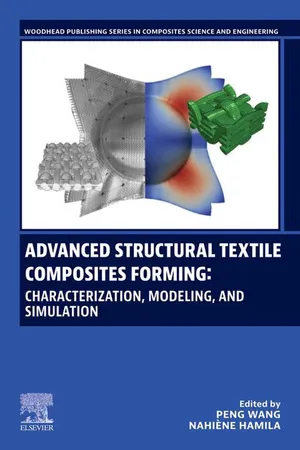
Advanced Structural Textile Composites Forming: Characterization, Modeling, and Simulation comprehensively describes the influence of fiber/fabric architectures and properties on composites forming, along with their deformability and structural optimization, covering the latest advances in the composites forming field. Part one reviews textile reinforcement architectures and discusses the forming behaviors of important 2D and 3D fabrics. Part two discusses numerical models to conduct simulation analysis of different structural composites forming at mesoscopic and macroscopic scales, in particular, 3D preforms with through-the-thickness yarns.Part three looks at the latest developments in the relationship between forming and other steps in composite manufacturing, such as resin injection, and automated fiber placement (AFP) and the effects on certain mechanical properties, such as structural damage and impact resistance. The book will be an essential reference for academic researchers, industrial engineers and materials scientists working with the manufacture and design of fiber-reinforced composite materials.
- Describes the influence of the fiber/fabric architectures and properties on composites forming, along with their deformability and structural optimization
- Provides numerical modeling and simulation of different fiber-reinforced composites forming at mesoscopic and macroscopic scales, in particular, reinforcements with discontinue fibers, and 3D preforms with through-the-thickness yarns
- Discusses cutting edge topics such as resin injection, and automated fiber placement (AFP) and the effects of forming results on mechanical properties such as structural damage and impact resistances
Information
Subtopic
Materials ScienceTable of contents
- Advanced Structural Textile Composites Forming
- 1 Classification of fiber reinforcement architecture
- 1.1: Introduction
- 2 Characterizing the forming mechanics of woven engineering fabrics
- 2.1: Introduction
- 3 Mechanical behaviors of braided fabrics during the forming
- 3.1: Introduction
- Chapter 4 Forming of non-crimp fabrics
- 4.1: Introduction
- 5 Deformability and preforming characterization of nonwoven fabrics
- 5.1: Introduction
- 6 Specificities of flax reinforcements: from plant growth to the forming of advanced composite materials
- 6.1: Introduction
- 7 Formability of warp and weft bound 3D weaves for composite reinforcements
- 7.1: Introduction
- 8 Formability of 3D orthogonal interlock woven composite reinforcement
- 8.1: Introduction
- 9 Formability of through-the-thickness tufted reinforcements
- 9.1: Introduction
- 10 Analysis and modeling of forming process at the mesoscale
- 10.1: The fabric forming process, a phenomenological approach
- 11 Forming simulations with macroscopic approach
- 11.1: Introduction
- 12 Modeling and simulation of the 3D interlock woven fabric forming
- 12.1: Introduction
- 13 Thermomechanical modeling and experimental characterization of continuous fiber-reinforced thermoplastic composites at forming temperatures
- 13.1: Introduction
- 14 Modeling of the forming process for multiple layer UHMWPE incorporating bending and thickness behaviors
- 14.1: Introduction
- 15 Emerging fast simulations using material point method
- 15.1: Introduction
- 16 Textile composite properties taking into account the preforming process
- 16.1: Preforming factors affecting textile properties
- 17 Composite preforming defects classification, involved mechanisms and induced mechanical properties
- 17.1: Introduction
- 18 Stabbing and ballistic resistances of the predeformed multiply three-dimensional interlock fabrics
- 18.1: Introduction
- 19 Fundamentals of fluid flow in fibrous preforms
- 19.1: Introduction
- 20 Composite parts designed for tailored fiber placement technology and the related manufacturing processes
- 20.1: Manufacturing processes to produce composite parts
- 21 Combining simulation methods and machine learning for efficient forming process development
- 21.1: Introduction
- 22 An industrial perspective on the present and future of thermoforming of prepregs: applications, trends, and challenges
- 22.1: Review of the state of the art
- Index
Trusted by 375,005 students
Access to over 1.5 million titles for a fair monthly price.
Study more efficiently using our study tools.
Frequently asked questions
Yes, you can cancel anytime from the Subscription tab in your account settings on the Perlego website. Your subscription will stay active until the end of your current billing period. Learn how to cancel your subscription
No, books cannot be downloaded as external files, such as PDFs, for use outside of Perlego. However, you can download books within the Perlego app for offline reading on mobile or tablet. Learn how to download books offline
Perlego offers two plans: Essential and Complete
- Essential is ideal for learners and professionals who enjoy exploring a wide range of subjects. Access the Essential Library with 800,000+ trusted titles and best-sellers across business, personal growth, and the humanities. Includes unlimited reading time and Standard Read Aloud voice.
- Complete: Perfect for advanced learners and researchers needing full, unrestricted access. Unlock 1.5M+ books across hundreds of subjects, including academic and specialized titles. The Complete Plan also includes advanced features like Premium Read Aloud and Research Assistant.
We are an online textbook subscription service, where you can get access to an entire online library for less than the price of a single book per month. With over 1.5 million books across 990+ topics, we’ve got you covered! Learn about our mission
Look out for the read-aloud symbol on your next book to see if you can listen to it. The read-aloud tool reads text aloud for you, highlighting the text as it is being read. You can pause it, speed it up and slow it down. Learn more about Read Aloud
Yes! You can use the Perlego app on both iOS and Android devices to read anytime, anywhere — even offline. Perfect for commutes or when you’re on the go.
Please note we cannot support devices running on iOS 13 and Android 7 or earlier. Learn more about using the app
Please note we cannot support devices running on iOS 13 and Android 7 or earlier. Learn more about using the app
Yes, you can access Advanced Structural Textile Composites Forming by Peng Wang,Nahiène Hamila in PDF and/or ePUB format, as well as other popular books in Technology & Engineering & Materials Science. We have over 1.5 million books available in our catalogue for you to explore.