eBook - ePub
Decoding the Osirian Myth
A Transcultural Reading of Plutarch’s Narrative
- 552 pages
- English
- ePUB (mobile friendly)
- Available on iOS & Android
eBook - ePub
About this book
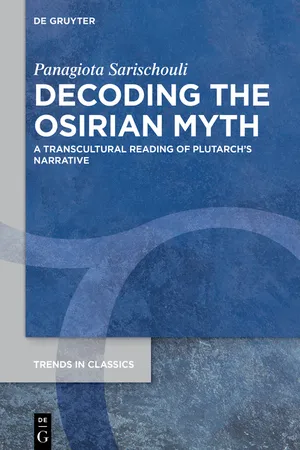
The earliest written references to the Osirian myth-complex appeared already in the Pyramid Text spells (c. 2400–2300 BCE). The most complete exposition of this ancient Egyptian myth is, however, found in the Greek treatise On Isis and Osiris, in which the 2nd-century CE Platonist Plutarch utilises Egyptian mythology to advocate his philosophical ideas concerning the divine and the nature of the cosmos. This book aims at "decoding" Plutarch's narrative of the Osirian myth, linking his claims to the existing Egyptian and Greek parallels. It thus analyses a multitude of mythic and religious traditions from a transcultural perspective, exploring the relation of the Pharaonic features of the Osirian divinities to the features they had acquired in Ptolemaic and Roman times, interpreting the Egyptian myth within the overall framework of parallel mythologies from other cultures, and examining whether the brief mythic stories (historiolae) recited in Late Egyptian ritual texts can be deployed to enrich the context of certain obscure episodes in Plutarch's account of the myth. The book will be of great interest not only to scholars and students of Plutarch and later Middle Platonism, but also to Egyptologists. Due to its thematic variety and scope, this publication will also appeal to a wider array of readers (specialists and non-specialists alike) interested in religious syncretism, interreligious connections, and the challenge of multiculturalism from Hellenistic times until Late Antiquity.
Information
Subtopic
Egyptian Ancient HistoryIndex
HistoryTable of contents
- Title Page
- Copyright
- Contents
- Acknowledgments
- Abbreviations
- Illustrations
- Maps
- Egyptian Chronology
- Introduction
- Part I: Plutarch
- Part II: Religious, Mythological and Magical Traditions
- Bibliography
- Index of Passages Cited
- Subject Index
Trusted by 375,005 students
Access to over 1.5 million titles for a fair monthly price.
Study more efficiently using our study tools.
Frequently asked questions
Yes, you can cancel anytime from the Subscription tab in your account settings on the Perlego website. Your subscription will stay active until the end of your current billing period. Learn how to cancel your subscription
No, books cannot be downloaded as external files, such as PDFs, for use outside of Perlego. However, you can download books within the Perlego app for offline reading on mobile or tablet. Learn how to download books offline
Perlego offers two plans: Essential and Complete
- Essential is ideal for learners and professionals who enjoy exploring a wide range of subjects. Access the Essential Library with 800,000+ trusted titles and best-sellers across business, personal growth, and the humanities. Includes unlimited reading time and Standard Read Aloud voice.
- Complete: Perfect for advanced learners and researchers needing full, unrestricted access. Unlock 1.5M+ books across hundreds of subjects, including academic and specialized titles. The Complete Plan also includes advanced features like Premium Read Aloud and Research Assistant.
We are an online textbook subscription service, where you can get access to an entire online library for less than the price of a single book per month. With over 1.5 million books across 990+ topics, we’ve got you covered! Learn about our mission
Look out for the read-aloud symbol on your next book to see if you can listen to it. The read-aloud tool reads text aloud for you, highlighting the text as it is being read. You can pause it, speed it up and slow it down. Learn more about Read Aloud
Yes! You can use the Perlego app on both iOS and Android devices to read anytime, anywhere — even offline. Perfect for commutes or when you’re on the go.
Please note we cannot support devices running on iOS 13 and Android 7 or earlier. Learn more about using the app
Please note we cannot support devices running on iOS 13 and Android 7 or earlier. Learn more about using the app
Yes, you can access Decoding the Osirian Myth by Panagiota Sarischouli in PDF and/or ePUB format, as well as other popular books in History & Egyptian Ancient History. We have over 1.5 million books available in our catalogue for you to explore.