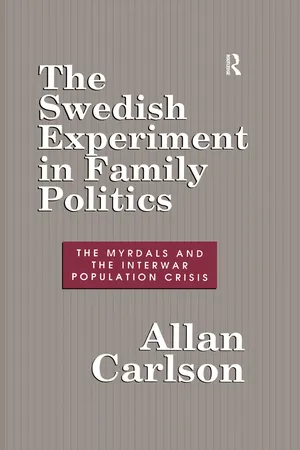
This devastating account of the work of Gunnar and Alva Myrdal is a monumental case study in the uses and abuses of social science. It portrays how these two young scholars used the power of ideas to help engineer a new domestic order in Sweden. The book focuses on the Myrdals' unique fusion of socialism and feminism with nationalism and pro-nationalism in their joint 1934 book, Crisis in the Population Question turning the issue of Sweden's declining birthrate into "the most effective argument for a radical socialist remodeling of society." The author uses interviews with many of the figures involved and extensive archival research (including restricted materials held by Sweden's Social Democratic Party) to weave an uncommonly personal account of triumphant social engineering.
The work of the Myrdals covered every major area of family policy and planning from a marriage loan program to maternity relief. Using theories and research of a then new science of demography, the Myrdals did not so much demonstrate the interpretation of facts and values as blue the distinction between them in order to insinuate ideological claims and policy mandates. Carlson provides careful historical documentation of social welfare and policy in Sweden, indicating the uneven path to the brave new "middle way." There was renewed emphasis on domesticity and traditionalism in the 1950s, and only in the 1980s was the Myrdal "revolution" truly completed. For Carlson that revolution was less a tribute to the Myrdals' perspicacity than to a concurrence of circumstances: weak and inconsistent data, confusion over cause and effect, and avoidance of controls in experimental settings.
Swedish experiments in marriage and family yielded a variety of results: a triumph of feminism over socialism; of reason over tradition, central government over regionalism, urban multi-family dwellings over suburban single family models, the therapeutic over the moral; and finally the state over the family. Because the Swedish "model" is widely regarded and emulated, this critique is of immediate significance. It offers the general reader remarkable insight into the nature of Scandinavian social life; and to the specialist in demography, economy, and sociology, a perspective on how social science can become itself the problem rather than provide solutions in contemporary post-industrial life.
Allan Carlson is president of the Rockford Institute, and a member of the National Commission on Children. He is the author of Family Questions: Reflections on the American Social Crisis.