A Taytsh Manifesto calls for a translational paradigm for Yiddish studies and for the study of modern Jewish culture. Saul Noam Zaritt calls for a shift in vocabulary, from Yiddish to taytsh, in order to promote reading strategies that account for the ways texts named as Jewish move between languages and cultures.
Yiddish, a moniker that became dominant only in the early twentieth century, means "Jewish" and thus marks the language with a single identity: of and for a Jewish collective. In contrast, this book calls attention to an earlier and, at one time, more common name for the language: taytsh, which initially means "German." By using the term taytsh, speakers indicated that they were indeed speaking a Germanic language, a language that was not entirely their own. In time, when the word shifted to a verb, taytshn, it came to mean the act of translation. To write or speak in Yiddish is thus to render into taytsh and inhabit the gap between languages.
A Taytsh Manifesto highlights the cultural porousness that inheres in taytsh and deploys the term as a paradigm that can be applied to a host of modern Jewish cultural formations. The book reads three corpora in modern Yiddish culture through the lens of translation: Yiddish pulp fiction, also known as shund (trash); the genre of the Yiddish monologue as authored by Sholem Aleichem and other prominent Yiddish writers; and the persistence of Yiddish as a language of vulgarity in contemporary U.S. culture. Together these examples help revise current histories of Yiddish while demonstrating the need for new vocabularies to account for the multidirectionality of Jewish culture. A Taytsh Manifesto develops a model for identifying, in Yiddish and beyond, how cultures intertwine, how they become implicated in world systems and empire, and how they might escape such limiting and oppressive structures.
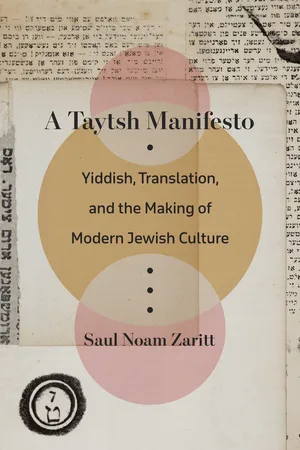
eBook - ePub
A Taytsh Manifesto
Yiddish, Translation, and the Making of Modern Jewish Culture
- 240 pages
- English
- ePUB (mobile friendly)
- Available on iOS & Android
eBook - ePub
About this book
Information
Publisher
Fordham University PressYear
2024Print ISBN
9781531509170
9781531509163
Edition
1eBook ISBN
9781531509187
Table of contents
- Cover
- Title Page
- Copyright
- Contents
- Note on Transliteration
- A Taytsh Manifesto—טײַטש, אַ מאַניפֿעסט
- Introduction: A Taytsh Paradigm
- 1. Yiddish Trash: Shund and the Politics of Translation
- 2. Yiddish Ghosts: The Monologue and the Story of Yiddish Literature
- 3. Yiddish Vulgarity: Translational Afterlives and Vernacular Discomfort
- Epilogue: From Taytsh to Jew Theory
- Acknowledgments
- Notes
- Works Cited
- Index
Trusted by 375,005 students
Access to over 1.5 million titles for a fair monthly price.
Study more efficiently using our study tools.
Frequently asked questions
Yes, you can cancel anytime from the Subscription tab in your account settings on the Perlego website. Your subscription will stay active until the end of your current billing period. Learn how to cancel your subscription
No, books cannot be downloaded as external files, such as PDFs, for use outside of Perlego. However, you can download books within the Perlego app for offline reading on mobile or tablet. Learn how to download books offline
Perlego offers two plans: Essential and Complete
- Essential is ideal for learners and professionals who enjoy exploring a wide range of subjects. Access the Essential Library with 800,000+ trusted titles and best-sellers across business, personal growth, and the humanities. Includes unlimited reading time and Standard Read Aloud voice.
- Complete: Perfect for advanced learners and researchers needing full, unrestricted access. Unlock 1.5M+ books across hundreds of subjects, including academic and specialized titles. The Complete Plan also includes advanced features like Premium Read Aloud and Research Assistant.
We are an online textbook subscription service, where you can get access to an entire online library for less than the price of a single book per month. With over 1.5 million books across 990+ topics, we’ve got you covered! Learn about our mission
Look out for the read-aloud symbol on your next book to see if you can listen to it. The read-aloud tool reads text aloud for you, highlighting the text as it is being read. You can pause it, speed it up and slow it down. Learn more about Read Aloud
Yes! You can use the Perlego app on both iOS and Android devices to read anytime, anywhere — even offline. Perfect for commutes or when you’re on the go.
Please note we cannot support devices running on iOS 13 and Android 7 or earlier. Learn more about using the app
Please note we cannot support devices running on iOS 13 and Android 7 or earlier. Learn more about using the app
Yes, you can access A Taytsh Manifesto by Saul Noam Zaritt in PDF and/or ePUB format, as well as other popular books in Social Sciences & Jewish History. We have over 1.5 million books available in our catalogue for you to explore.