- 116 pages
- English
- ePUB (mobile friendly)
- Available on iOS & Android
eBook - ePub
About this book
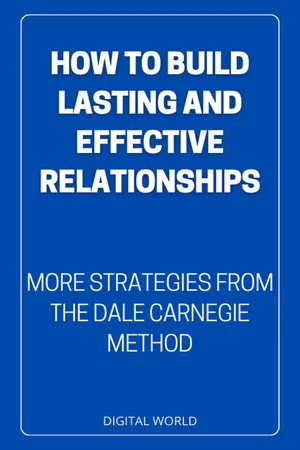
Dale Carnegie's book "How to Win Friends and Influence People" is one of the most popular self-help books in the world. First published in 1936, it has sold millions of copies worldwide and is considered one of the most influential works of the 20th century.
However, although many people have been inspired and influenced by Carnegie's book, the thesis of this e-book is that the method he proposes can have negative consequences on your interpersonal relationships.
In this book, we will examine each of the principles presented by Carnegie and critically analyze how they can be applied in real life.
We will argue that although some of the ideas presented in the book may have some value, many of them are simplistic and ignore the complexity of human relationships.
Rather than blindly following Carnegie's method, we advocate the importance of a more holistic and empathetic approach in our interactions with others. We believe it is essential to recognize the diversity of individual perspectives and needs and develop healthy, respectful human relationships based on mutual understanding and genuine dialogue.
Throughout this e-book, we hope to provide an alternative perspective to Carnegie's method and encourage readers to question their assumptions about what it means to "win friends" and "influence people."
Information
Subtopic
Development EconomicsIndex
PsychologyTable of contents
- Datasheet
- About the Publisher
- Introduction
- Chapter 1 The influence of self-image on the formation of friendships. Critical analysis of Carnegie's first principle: "Do not criticize, do not condemn, do not complain"
- Chapter 2 The importance of authenticity in personal relationships. Critical analysis of Carnegie's second principle: "Praise honestly and sincerely"
- Chapter 3 The need for limits and assertiveness. Critical Analysis of Carnegie's Third Principle: "Awaken a Burning Desire"
- Chapter 4 The role of empathy in building true friendships. Critical analysis of Carnegie's fourth principle: "Satisfy other people's desires"
- Chapter 5 The importance of diversity and respect for differences. Critical Analysis of Carnegie's Fifth Principle: "Appeal to Noble Motives"
- Chapter 6 The importance of active listening. Critical Analysis of Carnegie's Sixth Principle: "Give Sincere Attention to Others"
- Chapter 7 The importance of assertiveness. Critical Analysis of Carnegie's Seventh Principle: "Awaken a Burning Desire"
- Chapter 8 The importance of vulnerability. Critical analysis of Carnegie's eighth principle: "Draw attention to people's mistakes indirectly"
- Chapter 9 The importance of trust. Critical analysis of Carnegie's ninth principle: "Make the other person feel important, but with humility"
- Chapter 1 0 The importance of reciprocity. Critical analysis of Carnegie's tenth principle: "Seek to understand the other person's perspective"
- Chapter 1 1 The importance of dialogue and effective communication. Critical analysis of Carnegie's eleventh principle: "Present your ideas in an interesting way"
- Chapter 1 2 The importance of personal responsibility in relationships. Critical analysis of Carnegie's twelfth principle: "Earn the respect of others"
- Chapter 1 3 The importance of integrity. Critical Analysis of Carnegie's Thirteenth Principle: "Start Friendly"
- Chapter 1 4 The importance of reciprocity and commitment. Critical Analysis of Carnegie's Fourteenth Principle: "Draw Attention to Other People's Strengths"
- Chapter 1 5 The importance of flexibility and adaptation. Critical Analysis of Carnegie's Fifteenth Principle: "Be Friendly and Cordial"
- Chapter 1 6 The importance of mutual respect. Critical analysis of Carnegie's sixteenth principle: "Make the other person feel important, but without flattery"
- Chapter 1 7 The importance of emotional balance. Critical Analysis of Carnegie's Seventeenth Principle: "Be a Good Listener"
- Chapter 1 8 The importance of empathy and compassion. Critical analysis of Carnegie's eighteenth principle: "Speak about the other person's interests"
- Chapter 19 The Importance of Trust Analysis. critique of Carnegie's nineteenth principle: "Make the other person feel happy about what you say"
- Chapter 2 0 The importance of mutual trust. Critical analysis of Carnegie's twentieth principle: "Speak honestly and sincerely"
- Chapter 2 1 The importance of patience and tolerance. Carnegie's twenty-first principle is "Talk about your own experiences."
- Chapter 2 2 The importance of respecting diversity. Critical analysis of Carnegie's twenty-second principle: "Don't criticize, don't condemn, don't complain"
- Chapter 2 3 The importance of cooperation and teamwork. Critical Analysis of Carnegie's Twenty-Third Principle: "Act with Enthusiasm"
- Chapter 2 4 The importance of assertiveness and firmness. Critical analysis of Carnegie's twenty-fourth principle: "Begin with sincere praise"
- Chapter 2 5 The importance of empathy and active listening. Critical analysis of Carnegie's twenty-fifth principle: "Apologize when you are wrong"
- Chapter 2 6 The importance of honesty and transparency. Critical analysis of Carnegie's twenty-sixth principle: "Draw attention to the errors of others indirectly"
- Chapter 2 7 The importance of self-esteem and self-knowledge. Critical analysis of Carnegie's twenty-seventh principle: "Ask questions of the substitute from giving direct orders"
- Chapter 2 8 The importance of flexibility and adaptation. Critical analysis of Carnegie's twenty-eighth principle: "Allow the other person to save face"
- Conclusion
- Success Tags
Trusted by 375,005 students
Access to over 1.5 million titles for a fair monthly price.
Study more efficiently using our study tools.
Frequently asked questions
Yes, you can cancel anytime from the Subscription tab in your account settings on the Perlego website. Your subscription will stay active until the end of your current billing period. Learn how to cancel your subscription
No, books cannot be downloaded as external files, such as PDFs, for use outside of Perlego. However, you can download books within the Perlego app for offline reading on mobile or tablet. Learn how to download books offline
Perlego offers two plans: Essential and Complete
- Essential is ideal for learners and professionals who enjoy exploring a wide range of subjects. Access the Essential Library with 800,000+ trusted titles and best-sellers across business, personal growth, and the humanities. Includes unlimited reading time and Standard Read Aloud voice.
- Complete: Perfect for advanced learners and researchers needing full, unrestricted access. Unlock 1.5M+ books across hundreds of subjects, including academic and specialized titles. The Complete Plan also includes advanced features like Premium Read Aloud and Research Assistant.
We are an online textbook subscription service, where you can get access to an entire online library for less than the price of a single book per month. With over 1.5 million books across 990+ topics, we’ve got you covered! Learn about our mission
Look out for the read-aloud symbol on your next book to see if you can listen to it. The read-aloud tool reads text aloud for you, highlighting the text as it is being read. You can pause it, speed it up and slow it down. Learn more about Read Aloud
Yes! You can use the Perlego app on both iOS and Android devices to read anytime, anywhere — even offline. Perfect for commutes or when you’re on the go.
Please note we cannot support devices running on iOS 13 and Android 7 or earlier. Learn more about using the app
Please note we cannot support devices running on iOS 13 and Android 7 or earlier. Learn more about using the app
Yes, you can access How to Build Lasting and Effective Relationships by in PDF and/or ePUB format, as well as other popular books in Psychology & Development Economics. We have over 1.5 million books available in our catalogue for you to explore.