- 402 pages
- English
- ePUB (mobile friendly)
- Available on iOS & Android
About this book
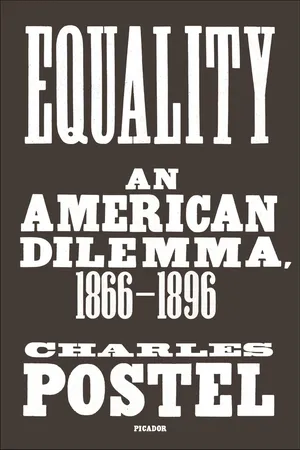
An in-depth study of American social movements after the Civil War and their lessons for today by a prizewinning historian
The Civil War unleashed a torrent of claims for equality—in the chaotic years following the war, former slaves, women's rights activists, farmhands, and factory workers all engaged in the pursuit of the meaning of equality in America. This contest resulted in experiments in collective action, as millions joined leagues and unions. In
Equality: An American Dilemma, 1866–1886, Charles Postel demonstrates how taking stock of these movements forces us to rethink some of the central myths of American history.
Despite a nationwide push for equality, egalitarian impulses oftentimes clashed with one another. These dynamics get to the heart of the great paradox of the fifty years following the Civil War and of American history at large: Waves of agricultural, labor, and women's rights movements were accompanied by the deepening of racial discrimination and oppression. Herculean efforts to overcome the economic inequality of the first Gilded Age and the sexual inequality of the late-Victorian social order emerged alongside Native American dispossession, Chinese exclusion, Jim Crow segregation, and lynch law.
Now, as Postel argues, the twenty-first century has ushered in a second Gilded Age of savage socioeconomic inequalities. Convincing and learned,
Equality explores the roots of these social fissures and speaks urgently to the need for expansive strides toward equality to meet our contemporary crisis.
Frequently asked questions
- Essential is ideal for learners and professionals who enjoy exploring a wide range of subjects. Access the Essential Library with 800,000+ trusted titles and best-sellers across business, personal growth, and the humanities. Includes unlimited reading time and Standard Read Aloud voice.
- Complete: Perfect for advanced learners and researchers needing full, unrestricted access. Unlock 1.4M+ books across hundreds of subjects, including academic and specialized titles. The Complete Plan also includes advanced features like Premium Read Aloud and Research Assistant.
Please note we cannot support devices running on iOS 13 and Android 7 or earlier. Learn more about using the app.
Information
Table of contents
- Cover
- Title Page
- Copyright Notice
- Dedication
- Introduction: Equality
- Part I: Farmers’ Grange
- Part II: Women’s Temperance
- Part III: Labor’s Knights
- Part IV: Crisis of Inequality
- Epilogue
- Notes
- Selected Bibliography
- Acknowledgments
- Index
- Also by Charles Postel
- A Note About the Author
- Newsletter Sign-up
- Contents
- Copyright