- 588 pages
- English
- ePUB (mobile friendly)
- Available on iOS & Android
About this book
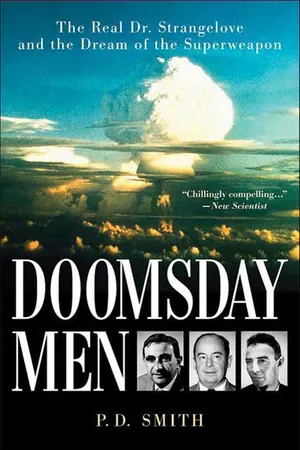
The gripping, untold story of the doomsday bomb—the ultimate weapon of mass destruction.
"Chillingly compelling." — New Scientist
In 1950, Hungarian-born scientist Leo Szilard made a dramatic announcement on American radio: science was on the verge of creating a doomsday bomb. For the first time in history, mankind realized that he had within his grasp a truly God-like power, the ability to destroy life itself. The shockwave from this statement reverberated across the following decade and beyond.
If detonated, Szilard's doomsday device—a huge cobalt-clad H-bomb—would pollute the atmosphere with radioactivity and end all life on earth. The scientific creators of such apocalyptic weapons had transformed the laws of nature into instruments of mass destruction and for many people in the Cold War there was little to distinguish real scientists from that "fictional master of megadeath," Stanley Kubrick's Dr. Strangelove. Indeed, as P. D. Smith's chilling account,
Doomsday Men, shows, the dream of the superweapon begins in popular culture. This is a story that cannot be told without the iconic films and fictions that portray our deadly fascination with superweapons, from H.G. Wells's
The War of the Worlds to Nevil Shute's
On the Beach and Kubrick's
Dr. Strangelove or: How I Learned to Stop Worrying and Love the Bomb.
Although scientists admitted it was possible to build the cobalt bomb, no superpower would admit to having created one. However, it remained a terrifying possibility, striking fear into the hearts of people around the world. The story of the cobalt bomb is an unwritten chapter of the Cold War, but now P. D. Smith reveals the personalities behind this feared technology and shows how the scientists responsible for the twentieth century's most terrible weapons grew up in a culture dreaming of superweapons and Wellsian utopias. He argues that, in the end, the doomsday machine became the ultimate symbol of humanity's deepest fears about the science of destruction.
"Weaving together biography, science and art, Smith has created a compelling history of physics in the twentieth century, focusing on the long-lasting search for ever more destructive weapons—from the development of chemical warfare in World War I Germany through the arms race of the Cold War. . . . Captivating and thoroughly referenced, this chronicle should interest a wide audience, from science and history buffs to armchair politicos." — Publishers Weekly
Frequently asked questions
- Essential is ideal for learners and professionals who enjoy exploring a wide range of subjects. Access the Essential Library with 800,000+ trusted titles and best-sellers across business, personal growth, and the humanities. Includes unlimited reading time and Standard Read Aloud voice.
- Complete: Perfect for advanced learners and researchers needing full, unrestricted access. Unlock 1.4M+ books across hundreds of subjects, including academic and specialized titles. The Complete Plan also includes advanced features like Premium Read Aloud and Research Assistant.
Please note we cannot support devices running on iOS 13 and Android 7 or earlier. Learn more about using the app.
Information
Table of contents
- Cover
- Title
- Copyright
- Dedication
- Contents
- List of Illustrations
- Acknowledgements
- Prologue: The Beginning Or The End?
- PART I: The Dream
- PART II: The Chemist’S War
- PART III: The Dark Heart of Matter
- PART IV: The Battle of The Laboratories
- PART V: The End of Dreams
- Epilogue: ‘The Tragedy of Mankind’
- Notes
- Bibliography
- Index