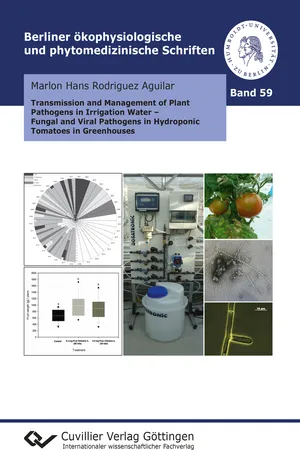
Recirculating fertigation solutions in hydroponic cultivation systems reduce production costs. They are environmentally friendly, especially because they minimize the consumption of fresh water. However, there is a high risk of epidemics due to accumulation and dispersal of plant pathogens via irrigation water. If the drain is not treated before reuse, even a few pathogens can jeopardize production and lead to high economic losses. This PhD-thesis analyzes and evaluates the eff ect of an electrolytically derived disinfectant, potassium hypochlorite (KClO), on various plant pathogens in tomato crops. In vitro and in vivo studies were conducted to determine i) the potential of the disinfectant to inactivate pathogens such as Tobacco mosaic virus and Pepino mosaic virus, Fusarium oxysporum f.sp. lycopersici and Rhizoctonia solani and ii) its suitability to prevent the spread of pathogens via fertigation solution in hydroponic tomato production.
- 89 pages
- English
- PDF
- Available on iOS & Android
eBook - PDF
About this book
Information
Edition
0Table of contents
- Table of content
- List of Abbreviations
- List of figures
- List of tables
- ZUSAMMENFASSUNG
- SUMMARY
- RESUMEN
- CHAPTER 1 General introduction
- CHAPTER 2 Plant viruses in irrigation water: reduced dispersal of viruses using sensor-based disinfection
- CHAPTER 3 Efficacy of electrolytically-derived disinfectant against dispersal of Fusarium oxysporum and Rhizoctonia solani in hydroponic tomatoes
- CHAPTER 4 Electrolytic Disinfection of Irrigation Water for Intensive Crop Production in Greenhouses as Demonstrated on Tomatoes (Solanum lycopersicum Mill)
- Chapter 5 General discussion
- Declaration of independence
- Eigenständigkeitserklärung
- Acknowledgment
Trusted by 375,005 students
Access to over 1.5 million titles for a fair monthly price.
Study more efficiently using our study tools.