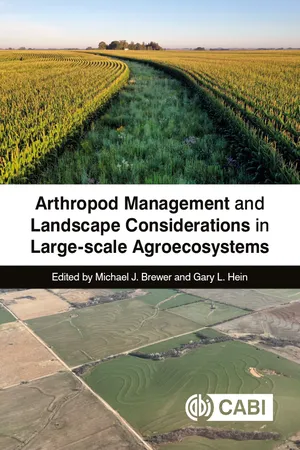
For large-scale agroecosystems, patterns of pest population increases (graded increases or abrupt outbreaks) and declines (graded suppression or abrupt crashes) vary considerably and are influenced by factors within crop fields and across broader landscape scales. Better understanding of pest population dynamics and the implications of spatial interactions on the function and development of pest management approaches are the main themes of this important book. The book builds from a 60+ year history of field-based pest management by focusing on the drivers of pest management in large-scale agroecosystems and the landscape-scale processes that affect these drivers and contribute to variation in pest outbreaks and suppression. These drivers include abiotic and biotic influences such as weather, spatial composition and arrangement of landscape elements, and widely applied managed inputs such as planting and crop rotation schedules, crop varietal selection, and land and soil conservation efforts. The book introduces general concepts, opportunities, and challenges of arthropod management in large-scale agroecosystems. Case studies from major field crop-based agroecosystems are used to present research approaches and improve understanding and management of pest and beneficial insects in large-scale agroecosystems. Specific research findings are provided on multi-trophic interactions within the system as influenced by climate, landscape, and other ecological, agricultural, and social/economic components of the agroecosystem. The book concludes with a synthesis of these concepts and prospectus for future research and developments in arthropod management in large-scale, plant-based agroecosystems. The book is essential reading for researchers in applied entomology and ecology and for pest management practitioners.
eBook - ePub
Arthropod Management and Landscape Considerations in Large-Scale Agroecosystems
- 296 pages
- English
- ePUB (mobile friendly)
- Available on iOS & Android
eBook - ePub
Arthropod Management and Landscape Considerations in Large-Scale Agroecosystems
About this book
Information
Table of contents
- Cover
- Title Page
- Copyright
- Contents
- Contributors
- Foreword by George G. Kennedy
- Foreword by Sanford D. Eigenbrode
- Foreword by Silvia I. Rondon
- Introduction
- Chapter 1 Influence of Spatial Scale on Landscape Effects Important to Arthropod Management
- Chapter 2 Pest Management for Spatially Variable Arthropod Pests in Large-scale Agroecosystems
- Chapter 3 Landscape Considerations in Pest Management: Case Study of the Arizona Cotton IPM System
- Chapter 4 Managing the Invasive Fall Armyworm in the Large- and Small-scale Maize Farming Landscapes of East and Southern Africa
- Chapter 5 Aphid Biological Control by Parasitoids in Winter Wheat and Canola in Heterogeneous Agricultural Landscapes
- Chapter 6 Ecology of Aphid Parasitoids in Winter Wheat Habitats of the Southern Plains: How Latitude and Crop Diversity Influence Pest Management
- Chapter 7 Cereal Aphids and Yellow Dwarf Viruses Among Wheat and Other Large-scale Agroecosystems of Central North America
- Chapter 8 Natural Enemy Suppression Supplemented by Regional Pest Management for the Invasive Melanaphis sorghi, Sorghum Aphid, on Sorghum
- Chapter 9 Western Corn Rootworm Resistance to Bt Maize within the Midwestern Agricultural Landscape
- Chapter 10 Linking Corn Earworm Populations and Management to Landscapes Across North America
- Chapter 11 Nature’s Workforce: Understanding the Role of Wild Bees in Agroecosystems
- Chapter 12 Honey Beekeeping in Agricultural Landscapes: Addressing the Stresses of Pesticide Exposure and Limited Forage
- Chapter 13 Future of Information Systems for Pest Management: Data Acquisition and Integration to Guiding Management Decisions
- Chapter 14 Past, Present, and Future Applications of Molecular Tools in Landscape-scale IPM: Fall Armyworm as a Case Study
- Index
- Back Cover
Trusted by 375,005 students
Access to over 1.5 million titles for a fair monthly price.
Study more efficiently using our study tools.
Frequently asked questions
Yes, you can cancel anytime from the Subscription tab in your account settings on the Perlego website. Your subscription will stay active until the end of your current billing period. Learn how to cancel your subscription
No, books cannot be downloaded as external files, such as PDFs, for use outside of Perlego. However, you can download books within the Perlego app for offline reading on mobile or tablet. Learn how to download books offline
Perlego offers two plans: Essential and Complete
- Essential is ideal for learners and professionals who enjoy exploring a wide range of subjects. Access the Essential Library with 800,000+ trusted titles and best-sellers across business, personal growth, and the humanities. Includes unlimited reading time and Standard Read Aloud voice.
- Complete: Perfect for advanced learners and researchers needing full, unrestricted access. Unlock 1.5M+ books across hundreds of subjects, including academic and specialized titles. The Complete Plan also includes advanced features like Premium Read Aloud and Research Assistant.
We are an online textbook subscription service, where you can get access to an entire online library for less than the price of a single book per month. With over 1.5 million books across 990+ topics, we’ve got you covered! Learn about our mission
Look out for the read-aloud symbol on your next book to see if you can listen to it. The read-aloud tool reads text aloud for you, highlighting the text as it is being read. You can pause it, speed it up and slow it down. Learn more about Read Aloud
Yes! You can use the Perlego app on both iOS and Android devices to read anytime, anywhere — even offline. Perfect for commutes or when you’re on the go.
Please note we cannot support devices running on iOS 13 and Android 7 or earlier. Learn more about using the app
Please note we cannot support devices running on iOS 13 and Android 7 or earlier. Learn more about using the app
Yes, you can access Arthropod Management and Landscape Considerations in Large-Scale Agroecosystems by Michael J Brewer,Gary L. Hein in PDF and/or ePUB format, as well as other popular books in Biological Sciences & Entomology. We have over 1.5 million books available in our catalogue for you to explore.