- 323 pages
- English
- ePUB (mobile friendly)
- Available on iOS & Android
eBook - ePub
About this book
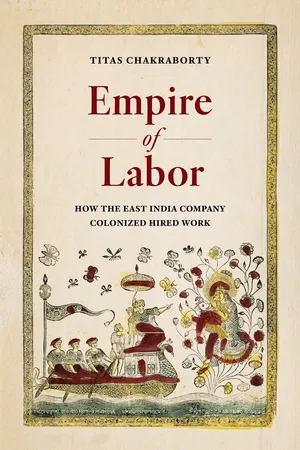
Empire of Labor tells the story of how hired workers experienced and responded to the rise to power over the long eighteenth century of the English East India Company (EIC), which perennially hired thousands of people in and around its settlements in Bengal. Focusing on boatmen and silk reelers as well as sailors and soldiers—a remarkable look at both indigenous and European workers—the story begins with the earliest accounts of the EIC's dealings with hired labor in the region, from 1651. Prior to EIC dominance, hired workers drove hard bargains with their employers, making demands that drew upon their own notions of wages, work rhythms, and time. When their demands were not met, they ran away, often to rival indigenous or European employers. Empire of Labor explores these demands and how they conflicted with the EIC's notions of discipline. Analyzing Bengali literary sources and Dutch and English archival materials, the book rethinks the ascendancy of the company state as a violent process involving removing competing employers, imposing army and police power, introducing new production technologies, and instituting draconian regulations which eliminated indigenous cultures of work. Most importantly, it depicts the lifeworlds of these recalcitrant workers, showing how they lived and resisted. A major intervention in histories of colonialism, labor, migration, and law, Empire of Labor ultimately recasts colonial rule as a novel form of state-labor relationship.
Information
Table of contents
- Title
- Copyright
- Dedication
- Contents
- List of Illustrations
- Preface
- Introduction
- 1. Beruniẏās of Bengal: Mobile Hired Work and the State in Seventeenth- and Early Eighteenth-Century Bengal
- 2. “Quarrelsome Workers”: Boatmen in the Early Eighteenth-Century Company State
- 3. “I Would Rather Be the Foremost Prince of Any Lower Court”: European Sailors and Soldiers in the Early Eighteenth-Century Company State
- 4. “Less Than the Lowest Class of Laborers”: Silk Reelers and the Company State, 1650–1779
- 5. “Prisoner” of the Magistrate: Boatmen, European Sailors, and the Colonial Police, 1790–1817
- Conclusion: A Colonial Rule over Labor
- Glossary
- Notes
- Bibliography of Primary Sources
- Index
Trusted by 375,005 students
Access to over 1.5 million titles for a fair monthly price.
Study more efficiently using our study tools.
Frequently asked questions
Yes, you can cancel anytime from the Subscription tab in your account settings on the Perlego website. Your subscription will stay active until the end of your current billing period. Learn how to cancel your subscription
No, books cannot be downloaded as external files, such as PDFs, for use outside of Perlego. However, you can download books within the Perlego app for offline reading on mobile or tablet. Learn how to download books offline
Perlego offers two plans: Essential and Complete
- Essential is ideal for learners and professionals who enjoy exploring a wide range of subjects. Access the Essential Library with 800,000+ trusted titles and best-sellers across business, personal growth, and the humanities. Includes unlimited reading time and Standard Read Aloud voice.
- Complete: Perfect for advanced learners and researchers needing full, unrestricted access. Unlock 1.5M+ books across hundreds of subjects, including academic and specialized titles. The Complete Plan also includes advanced features like Premium Read Aloud and Research Assistant.
We are an online textbook subscription service, where you can get access to an entire online library for less than the price of a single book per month. With over 1.5 million books across 990+ topics, we’ve got you covered! Learn about our mission
Look out for the read-aloud symbol on your next book to see if you can listen to it. The read-aloud tool reads text aloud for you, highlighting the text as it is being read. You can pause it, speed it up and slow it down. Learn more about Read Aloud
Yes! You can use the Perlego app on both iOS and Android devices to read anytime, anywhere — even offline. Perfect for commutes or when you’re on the go.
Please note we cannot support devices running on iOS 13 and Android 7 or earlier. Learn more about using the app
Please note we cannot support devices running on iOS 13 and Android 7 or earlier. Learn more about using the app
Yes, you can access Empire of Labor by Titas Chakraborty in PDF and/or ePUB format, as well as other popular books in History & Labour Economics. We have over 1.5 million books available in our catalogue for you to explore.