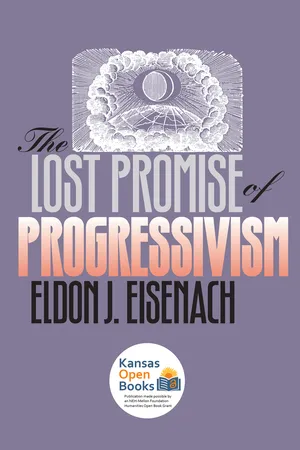
Long before the current calls for national service, civic responsibility, and the restoration of community values, the Progressives initiated a remarkably similar challenge. Eldon Eisenach traces the evolution of this powerful national movement from its theoretical origins through its dramatic rise and sudden demise, and shows why their philosophy still speaks to us with such eloquence.
Eisenach analyzes how and why, between 1885 and World War I, progressive political ideas conquered almost every cultural and intellectual bastion except constitutional law and dominated every major national institution except the courts and party system. Progressives, he demonstrates, were especially influential as a force in American politics, higher education, and the media. They created wideranging professional networks that functioned like a “hidden national government” to counter a federal government they deeply distrusted. They viewed the university as their national “Church”—the main repository and disseminator of values they espoused. They established truly national journals for a national audience. And they drew much support from women’s rights advocates and other highly vocal movements of their time.
Permeated with an evangelical Protestant vision of the future, progressive thought was an integral part of the national discourse for nearly three decades. But, as Eisenach reveals, at the very moment of its triumph it disintegrated as both a coherent theory and a viable public doctrine. With the election in 1912 of Woodrow Wilson, the movement reached its peak, but thereafter lost its momentum and force. Its precipitous decline was accelerated by world war and by the rise of New Deal liberalism. By the end of the Depression it had disappeared as an influential player in American public life.
In the decades that followed, the Progressive mantle went unclaimed. Conservatives blamed the Progressives for the rise of the welfare state and many liberals cringed at their theological and imperialist rhetoric. Eisenach, however, argues that we still have much to learn about and from the Progressives. By enlarging our understanding of their thought, we greatly increase our understanding of an America whose national institutions—political, cultural, educational, religious, professional, economic, and journalistic—are all largely the product of this thinking. In other words, their ideas are still very much with us.
Open access edition funded by the National Endowment for Humanities and the Andrew W. Mellon Foundation Humanities Open Book Program.