2025 John Brinckerhoff Jackson Prize, Association of American Geographers
2025 Abbott Lowell Cummings Award
2025 John Brinckerhoff Jackson Prize, UVA Center for Cultural Landscapes
2026 Hagley Prize in Business History, Hagley Museum and Library
2025 Honorable Mention, PROSE Award, Association of American Publishers (AAP)
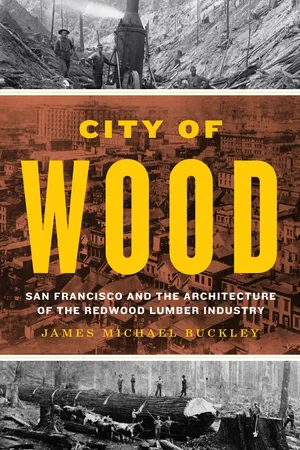
California's 1849 gold rush triggered creation of the "instant city" of San Francisco as a base to exploit the rich natural resources of the American West. City of Wood examines how capitalists and workers logged the state's vast redwood forests to create the financial capital and construction materials needed to build the regional metropolis of San Francisco. Architectural historian James Michael Buckley investigates the remote forest and its urban core as two poles of a regional "city." This city consisted of a far-reaching network of spaces, produced as company owners and workers arrayed men and machines to extract resources and create human commodities from the region's rich natural environment.
Combining labor, urban, industrial, and social history, City of Wood employs a variety of sources—including contemporary newspaper articles, novels, and photographs—to explore the architectural landscape of lumber, from backwoods logging camps and company towns in the woods to busy lumber docks and the homes of workers and owners in San Francisco. By imagining the redwood lumber industry as a single community spread across multiple sites—a "City of Wood"—Buckley demonstrates how capitalist resource extraction links different places along the production value chain. The result is a paradigm shift in architectural history that focuses not just on the evolution of individual building design across time, but also on economic connections that link the center and periphery across space.