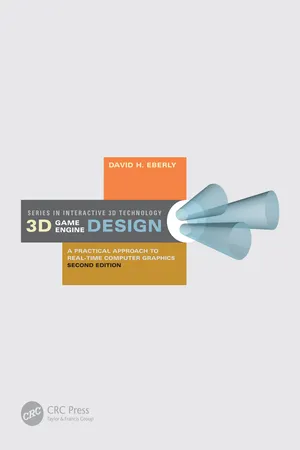
3D Game Engine Design
eBook - ePub

3D Game Engine Design

A Practical Approach to Real-Time Computer Graphics

  1. 1,040 pages
  2. English
  3. ePUB (mobile friendly)
  4. Available on iOS & Android
eBook - ePub

3D Game Engine Design

A Practical Approach to Real-Time Computer Graphics

About this book

The first edition of 3D Game Engine Design was an international bestseller that sold over 17,000 copies and became an industry standard. In the six years since that book was published, graphics hardware has evolved enormously. Hardware can now be directly controlled through techniques such as shader programming, which requires an entirely new thought process of a programmer.

In a way that no other book can do, this new edition shows step by step how to make a shader-based graphics engine and how to tame this new technology. Much new material has been added, including more than twice the coverage of the essential techniques of scene graph management, as well as new methods for managing memory usage in the new generation of game consoles and portable game players. There are expanded discussions of collision detection, collision avoidance, and physics—all challenging subjects for developers. The mathematics coverage is now focused towards the end of the book to separate it from the general discussion.

As with the first edition, one of the most valuable features of this book is the inclusion of Wild Magic, a commercial quality game engine in source code that illustrates how to build a real-time rendering system from the lowest-level details all the way to a working game. Wild Magic Version 4 consists of over 300,000 lines of code that allows the results of programming experiments to be seen immediately. This new version of the engine is fully shader-based, runs on Windows XP, Mac OS X, and Linux, and is only available with the purchase of the book.

Frequently asked questions

Yes, you can cancel anytime from the Subscription tab in your account settings on the Perlego website. Your subscription will stay active until the end of your current billing period. Learn how to cancel your subscription.
No, books cannot be downloaded as external files, such as PDFs, for use outside of Perlego. However, you can download books within the Perlego app for offline reading on mobile or tablet. Learn more here.
Perlego offers two plans: Essential and Complete
  • Essential is ideal for learners and professionals who enjoy exploring a wide range of subjects. Access the Essential Library with 800,000+ trusted titles and best-sellers across business, personal growth, and the humanities. Includes unlimited reading time and Standard Read Aloud voice.
  • Complete: Perfect for advanced learners and researchers needing full, unrestricted access. Unlock 1.4M+ books across hundreds of subjects, including academic and specialized titles. The Complete Plan also includes advanced features like Premium Read Aloud and Research Assistant.
Both plans are available with monthly, semester, or annual billing cycles.
We are an online textbook subscription service, where you can get access to an entire online library for less than the price of a single book per month. With over 1 million books across 1000+ topics, we’ve got you covered! Learn more here.
Look out for the read-aloud symbol on your next book to see if you can listen to it. The read-aloud tool reads text aloud for you, highlighting the text as it is being read. You can pause it, speed it up and slow it down. Learn more here.
Yes! You can use the Perlego app on both iOS or Android devices to read anytime, anywhere — even offline. Perfect for commutes or when you’re on the go.
Please note we cannot support devices running on iOS 13 and Android 7 or earlier. Learn more about using the app.
Yes, you can access 3D Game Engine Design by David Eberly in PDF and/or ePUB format, as well as other popular books in Art & Programming Games. We have over one million books available in our catalogue for you to explore.

Information

Publisher
CRC Press
Year
2006
eBook ISBN
9781040076163

Table of contents

  1. Cover
  2. Halftitle Page
  3. Frontmatter
  4. Title Page
  5. Copyright Page
  6. Trademarks
  7. About The Author
  8. Table of Contents
  9. Preface
  10. Chapter 1: Introduction
  11. Chapter 2: The Graphics System
  12. Chapter 3: Renderers
  13. Chapter 4: Scene Graphs
  14. Chapter 5: Controller-Based Animation
  15. Chapter 6: Spatial Sorting
  16. Chapter 7: Level of Detail
  17. Chapter 8: Collision Detection
  18. Chapter 9: Physics
  19. Chapter 10: Standard Objects
  20. Chapter 11: Curves
  21. Chapter 12: Surfaces
  22. Chapter 13: Containment Methods
  23. Chapter 14: Distance Methods
  24. Chapter 15: Intersection Methods
  25. Chapter 16: Numerical Methods
  26. Chapter 17: Rotations
  27. Chapter 18: Object-Oriented Infrastructure
  28. Chapter 19: Memory Management
  29. Chapter 20: Special Effects Using Shaders
  30. Appendix
  31. References
  32. Index
  33. About Thecd-Rom