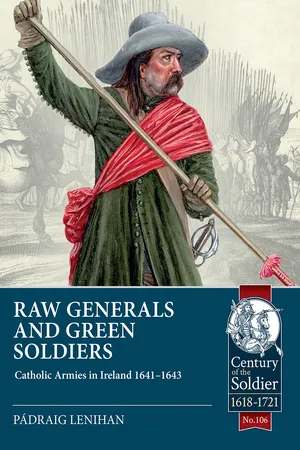
The eleven years of conflict that engulfed Ireland (1641-53) can be seen as a drama in three acts, each of which drew Ireland into progressively closer alignment with the Civil Wars (1642-52) in the other two Stuart kingdoms, Scotland and England. The first act in the Wars of Religion in Ireland (1641-53) began in October 1641 with a rising in Ulster and shuddered to a halt in September 1643 when the insurgents, now embodied as the Confederate Catholics, agreed a ceasefire with Charles I's representative in Ireland. This study is confined to Act One to manage its sheer scope and scale. Not a single county in Ireland was unscathed by war and in summer 1642 there were more men under arms than there ever had been or would be again. Moreover, Act One was singularly nasty. Insurgent slaughter of Protestant settlers in the winter of 1641-42 quickly gained canonical status. English and Scots armies routinely massacred natives in the spring and summer that followed. After their uprising failed, the Irish in 1642 were attacked by English and Scottish armies that were bigger, in aggregate, than any before or since. And that includes the armies of Elizabeth I, Oliver Cromwell and William of Orange. Lacking munitions, forced to disperse their strength, and usually outfought in open battle, the Confederate Catholics pushed back in war-as-process and food-fights in which castles dominating a chequerboard of hinterlands jostled with hostile neighbors. The Catholics were winning this small war when the music stopped in 1643. This is a study of the Catholic armies in Act One through a succinct narrative which reveals underlying pattern and purpose in what would otherwise be one apparently random battle, siege, skirmish, massacre, and cattle raid after another, devoid of form or meaning. The narrative focuses in and out, from the strategic through the operational down to the tactical and what happened in a particular place on a given day. The narrative also shifts from the southern or Leinster/Munster theater to the northern or Connacht/Ulster theater. Meaning is disclosed through narrative in which the strengths and shortcomings of the Irish armies become clearer. The quotation in the title sets up two such shortcomings, of leaders and led. One reason why the Catholics lost so many battles may be that their generals fought battles when they needn't have, showed a fatal preference for the all-out attack, and did not always deploy in a manner that let their army's components, pike, shot and horse act in mutual support. Another reason may be that the rankers were less invested in the Catholic cause than their officers. But the establishing quotation is followed by a question mark. Perhaps the real question to be asked is how the Catholic armies achieved so much rather than why they failed.
- 186 pages
- English
- ePUB (mobile friendly)
- Available on iOS & Android
eBook - ePub
About this book
Information
Table of contents
- Cover
- Title
- Copyright
- Acknowledgements
- Glossary of Terms
- Author’s Note
- Introduction
- 1 Winter 1641–1642
- 2 Summer and Autumn 1642
- 3 Winter 1642–1643
- 4 Summer 1643
- Conclusion
- Colour Plate Commentaries
- Bibliography
- Plates
Trusted by 375,005 students
Access to over 1.5 million titles for a fair monthly price.
Study more efficiently using our study tools.
Frequently asked questions
Yes, you can cancel anytime from the Subscription tab in your account settings on the Perlego website. Your subscription will stay active until the end of your current billing period. Learn how to cancel your subscription
No, books cannot be downloaded as external files, such as PDFs, for use outside of Perlego. However, you can download books within the Perlego app for offline reading on mobile or tablet. Learn how to download books offline
Perlego offers two plans: Essential and Complete
- Essential is ideal for learners and professionals who enjoy exploring a wide range of subjects. Access the Essential Library with 800,000+ trusted titles and best-sellers across business, personal growth, and the humanities. Includes unlimited reading time and Standard Read Aloud voice.
- Complete: Perfect for advanced learners and researchers needing full, unrestricted access. Unlock 1.5M+ books across hundreds of subjects, including academic and specialized titles. The Complete Plan also includes advanced features like Premium Read Aloud and Research Assistant.
We are an online textbook subscription service, where you can get access to an entire online library for less than the price of a single book per month. With over 1.5 million books across 990+ topics, we’ve got you covered! Learn about our mission
Look out for the read-aloud symbol on your next book to see if you can listen to it. The read-aloud tool reads text aloud for you, highlighting the text as it is being read. You can pause it, speed it up and slow it down. Learn more about Read Aloud
Yes! You can use the Perlego app on both iOS and Android devices to read anytime, anywhere — even offline. Perfect for commutes or when you’re on the go.
Please note we cannot support devices running on iOS 13 and Android 7 or earlier. Learn more about using the app
Please note we cannot support devices running on iOS 13 and Android 7 or earlier. Learn more about using the app
Yes, you can access Raw Generals and Green Soldiers by Pádraig Lenihan in PDF and/or ePUB format, as well as other popular books in History & British History. We have over 1.5 million books available in our catalogue for you to explore.