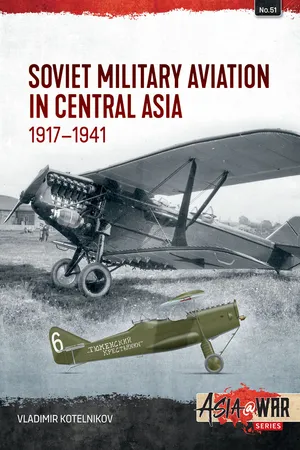
The utilization of air power by the Communist regime in Russia during the revolutionary period and civil war to control its territories in Central Asia is an intriguing aspect of military history often overlooked in Western narratives. The region, which bordered Iran, Afghanistan, and China, and included the ancient cities of Samarkand and Bukhara, held strategic significance for both the Russian Empire and the subsequent USSR. Attempts to impose Russian or communist ideologies on the indigenous tribal populations clashed with deeply rooted Islamic traditions, leading to resistance movements such as the Basmachi uprising. The Basmachi insurgency, viewed as defenders of traditional tribal values by the local populace, was perceived as mere banditry by the Russian and Soviet authorities. Policing such vast and challenging terrain, where environmental conditions posed significant hazards alongside armed opposition, necessitated innovative approaches. Consequently, the Soviets turned to air power as a means of controlling these remote regions. Despite inventive tactics, the aircraft employed by the Soviets in Central Asia during the inter-war period were often outdated, worn-out, or repurposed from other theaters of operation. This reliance on obsolete or marginal aircraft highlights the resource constraints faced by the Soviet military during this tumultuous period. Soviet Military Aviation in Central Asia: 1917–41 offers a detailed exploration of the inter-war use of air power in Soviet Central Asia, drawing from Russian-language sources and photographic archives. The book provides insights into the challenges faced by the Soviet military in maintaining control over the region, accompanied by rare photographs and unique color artworks depicting the aircraft utilized during this era. Through this lens, readers can gain a deeper understanding of the complexities of military strategy and conflict in Central Asia during the early twentieth century.
- 58 pages
- English
- ePUB (mobile friendly)
- Available on iOS & Android
eBook - ePub
Soviet Military Aviation in Central Asia 1917-41
About this book
Information
Table of contents
- Cover
- Copyright
- Contents
- Abbreviation
- Introduction
- 1 Two Revolutions and a Civil War
- 2 Basmachi
- 3 The End of the Emirate of Bukhara
- 4 And the Basmachi Again
- 5 Military Service of Dobrolyot
- 6 Reorganisation and Modernisation
- 7 Special Operations Air Group
- 8 The First Air Assault
- 9 The Brave Air Assault of Brigade Commander Shapkin
- 10 Secret Invasion
- 11 Conversion to R-3LD
- 12 A New Outbreak
- 13 Kara-Kum Campaign
- 14 The Year of 1932
- 15 Establishing the OGPU Aviation
- 16 At the End of the Long War
- 17 Operation in Xinjiang
- 18 In the Early 1940s
- Bibliography
- About the Author
- Plates
Trusted by 375,005 students
Access to over 1.5 million titles for a fair monthly price.
Study more efficiently using our study tools.
Frequently asked questions
Yes, you can cancel anytime from the Subscription tab in your account settings on the Perlego website. Your subscription will stay active until the end of your current billing period. Learn how to cancel your subscription
No, books cannot be downloaded as external files, such as PDFs, for use outside of Perlego. However, you can download books within the Perlego app for offline reading on mobile or tablet. Learn how to download books offline
Perlego offers two plans: Essential and Complete
- Essential is ideal for learners and professionals who enjoy exploring a wide range of subjects. Access the Essential Library with 800,000+ trusted titles and best-sellers across business, personal growth, and the humanities. Includes unlimited reading time and Standard Read Aloud voice.
- Complete: Perfect for advanced learners and researchers needing full, unrestricted access. Unlock 1.5M+ books across hundreds of subjects, including academic and specialized titles. The Complete Plan also includes advanced features like Premium Read Aloud and Research Assistant.
We are an online textbook subscription service, where you can get access to an entire online library for less than the price of a single book per month. With over 1.5 million books across 990+ topics, we’ve got you covered! Learn about our mission
Look out for the read-aloud symbol on your next book to see if you can listen to it. The read-aloud tool reads text aloud for you, highlighting the text as it is being read. You can pause it, speed it up and slow it down. Learn more about Read Aloud
Yes! You can use the Perlego app on both iOS and Android devices to read anytime, anywhere — even offline. Perfect for commutes or when you’re on the go.
Please note we cannot support devices running on iOS 13 and Android 7 or earlier. Learn more about using the app
Please note we cannot support devices running on iOS 13 and Android 7 or earlier. Learn more about using the app
Yes, you can access Soviet Military Aviation in Central Asia 1917-41 by Vladimir Kotelnikov,Gennady Sloutskiy in PDF and/or ePUB format, as well as other popular books in History & Central Asian History. We have over 1.5 million books available in our catalogue for you to explore.