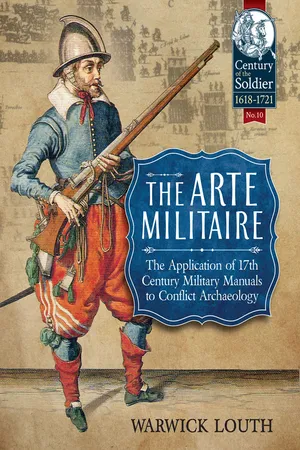
Military manuals have been used as a source through a range of historical studies, but only recently has their potential to Conflict Archaeology truly been recognized. Military manuals allowed the progression of the Military Revolution from the informed amateur towards the scientific, mathematical choreography for massed troops at the height of the Military Revolution, and their use as a viable historical resource often taken at face value - negating their worth. Using correlated GIS, landscape archaeology, metal detecting, military knowledge and experimental archaeology, we might understand more fully the limitations and strengths drill books provide us. Like a dance, military theory provides a certain number of ways individuals may progress through a landscape. Using examples taken from recent investigations at sites such as Edgehill, Lutzen and Lostwithiel, this paper shall examine to what extent individual drill can be identified in the archaeological record. This publication hopes to prove to what level and extent this can be applied to predictive modeling of artifact collections on battlefields - thus providing depth to the archaeological study of fields of conflict. Like investigations on the Little Bighorn battlefield, through use of wear analysis of the material remains of conflict, we can effectively tell the nuances of individual drill, practice and movement of people across a landscape; their drill actively mirroring subtleties in our understanding of interpretation. Taking the works of such writers and artists as Bariffe, de Gheyn and Ward, the author attempts to actively break down how individual and group drill will leave material remains and the archaeological means these might be taken down, but equally, this work also attempts to investigate and breach the subject of whether such manuals can also be used to dictate the survivability of 17th century fortifications - often within urban landscapes devoid of their civil war origins, as can be seen at Alton and Basing House. Theoretical in its nature and utilizing and combining elements of research not previously collaborated, The Arte Militaire is unique in not merely showing how military manuals were used, but rather how they can still be seen within the historical landscape.
eBook - ePub
The Arte Militaire
The Application of 17th Century Military Manuals to Conflict Archaeology
- 88 pages
- English
- ePUB (mobile friendly)
- Available on iOS & Android
eBook - ePub
The Arte Militaire
The Application of 17th Century Military Manuals to Conflict Archaeology
About this book
Information
Table of contents
- Cover
- Title
- Copyright
- Contents
- Foreword
- Acknowledgements
- Glossary
- 1 Introduction
- 2 Hypothesis
- 3 Theory and Method
- 4 What is a Military Manual?
- 5 Artefactual Trends
- 6 Irregular Warfare
- 7 Agent-Based Modelling
- 8 Historical Re-enactment and Experimental Archaeology
- 9 Lutzen
- 10 Edgehill
- 11 Cheriton
- 12 Naseby
- 13 Original Research
- 14 Tywardreath/Lostwithiel
- 15 Further Heritage Potential
- 16 Defensive Modelling
- 17 Defensive Planning
- 18 Primary Source Material
- 19 Trends
- 20 Destruction
- 21 Theoretical Modelling
- 22 Experimental Archaeology
- 23 Basing House
- 24 Alton
- 25 Conclusion
- Appendices: Author’s Note
- Bibliography
Trusted by 375,005 students
Access to over 1.5 million titles for a fair monthly price.
Study more efficiently using our study tools.
Frequently asked questions
Yes, you can cancel anytime from the Subscription tab in your account settings on the Perlego website. Your subscription will stay active until the end of your current billing period. Learn how to cancel your subscription
No, books cannot be downloaded as external files, such as PDFs, for use outside of Perlego. However, you can download books within the Perlego app for offline reading on mobile or tablet. Learn how to download books offline
We are an online textbook subscription service, where you can get access to an entire online library for less than the price of a single book per month. With over 1.5 million books across 990+ topics, we’ve got you covered! Learn about our mission
Look out for the read-aloud symbol on your next book to see if you can listen to it. The read-aloud tool reads text aloud for you, highlighting the text as it is being read. You can pause it, speed it up and slow it down. Learn more about Read Aloud
Yes! You can use the Perlego app on both iOS and Android devices to read anytime, anywhere — even offline. Perfect for commutes or when you’re on the go.
Please note we cannot support devices running on iOS 13 and Android 7 or earlier. Learn more about using the app
Please note we cannot support devices running on iOS 13 and Android 7 or earlier. Learn more about using the app
Yes, you can access The Arte Militaire by Warwick Louth in PDF and/or ePUB format, as well as other popular books in Social Sciences & Early Modern History. We have over 1.5 million books available in our catalogue for you to explore.