The extraordinary multiplicity of religions and religious cultures in India, chronicled over two thousand years
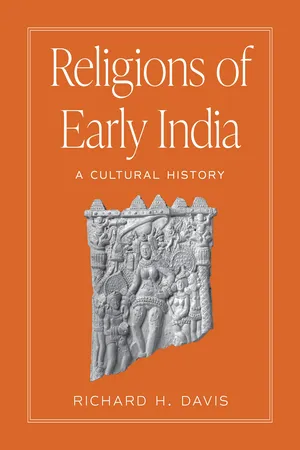
From its earliest recorded history, India was a place of remarkable and varied religious activity, ranging from elaborate sacrificial rituals and rigorous regimes of personal austerity to psycho-spiritual experimentation and utopian visions. In this ambitious and wide-ranging chronicle, Richard Davis offers a history of India’s myriad religious cultures that spans two thousand years, from 1300 BCE to 700 CE. India, Davis writes, was not only the birthplace of the religions we now know as Hinduism, Buddhism, and Jainism. It was also the home of other, often unnamed religions that can be classified as “folk” or “popular” religions. Tracing these intertwined practices, Davis shows that the ardent and heterogeneous religious cultures of early India came to define and redefine themselves in relation to one another.
Davis recounts this history through voices—voices recorded in hymns, poems, songs, didactic stories, epic narratives, scientific treatises, and theological discourses, as well as voices that speak through material remains, whether monumental sculptures or tiny terracotta figurines of nameless goddesses. He focuses on the long millennium often designated as “classical India,” which stretches from the time of the founding figures of Buddhism and Jainism during the sixth century BCE through the seventh-century-CE dynasties of the Chalukyas and the Pallavas in southern India. Throughout, he emphasizes encounter, interaction, debate, critique, and borrowing among religious communities within a shared, changing social and political reality. The voices and visions of early India’s religions, Davis shows us, are fascinating in their multiplicity.
- 617 pages
- English
- PDF
- Available on iOS & Android
eBook - PDF
About this book
Information
Topic
Theology & ReligionSubtopic
Indian & South Asian HistoryTable of contents
- Cover
- Contents
- List of Illustrations
- List of Maps
- Abbreviations
- Preface and Acknowledgments
- Introduction
- 1. The Living Landscape of India
- 2. Indo-Aryans and the Vision of the Rig Veda Poets (1300–1000 BCE)
- 3. The World of Sacrifice (1000–600 BCE)
- 4. A New Urban Culture and Renunciatory Religion (600–300 BCE)
- 5. The Mauryan Era: Religious Cultures of Empire (321–187 BCE)
- 6. Disciplinary Communities and Religious Quests
- 7. Popular Religious Cultures during the Shunga Era (200 BCE–0 CE)
- 8. The Sanskrit Epics: Imagined Empires of the Hindus
- Color Plates
- 9. The Kushana Era and Pan-Asian Buddhism (0 CE–300 CE)
- 10. Visual Religion: Icons, Worship, and Devotion
- 11. The Four Human Aims: Guides for the Good Life
- 12. The Gupta Era: Religious Cultures of Court and Beyond (300–500 CE)
- 13. The Puranas: Varieties of Hindu Theism
- 14. Homes for Gods (460 CE–700 CE)
- Epilogue. Varieties of Religious Cultures in Early India
- Notes
- Bibliography
- Index
Trusted by 375,005 students
Access to over 1.5 million titles for a fair monthly price.
Study more efficiently using our study tools.
Frequently asked questions
Yes, you can cancel anytime from the Subscription tab in your account settings on the Perlego website. Your subscription will stay active until the end of your current billing period. Learn how to cancel your subscription
No, books cannot be downloaded as external files, such as PDFs, for use outside of Perlego. However, you can download books within the Perlego app for offline reading on mobile or tablet. Learn how to download books offline
Perlego offers two plans: Essential and Complete
- Essential is ideal for learners and professionals who enjoy exploring a wide range of subjects. Access the Essential Library with 800,000+ trusted titles and best-sellers across business, personal growth, and the humanities. Includes unlimited reading time and Standard Read Aloud voice.
- Complete: Perfect for advanced learners and researchers needing full, unrestricted access. Unlock 1.5M+ books across hundreds of subjects, including academic and specialized titles. The Complete Plan also includes advanced features like Premium Read Aloud and Research Assistant.
We are an online textbook subscription service, where you can get access to an entire online library for less than the price of a single book per month. With over 1.5 million books across 990+ topics, we’ve got you covered! Learn about our mission
Look out for the read-aloud symbol on your next book to see if you can listen to it. The read-aloud tool reads text aloud for you, highlighting the text as it is being read. You can pause it, speed it up and slow it down. Learn more about Read Aloud
Yes! You can use the Perlego app on both iOS and Android devices to read anytime, anywhere — even offline. Perfect for commutes or when you’re on the go.
Please note we cannot support devices running on iOS 13 and Android 7 or earlier. Learn more about using the app
Please note we cannot support devices running on iOS 13 and Android 7 or earlier. Learn more about using the app
Yes, you can access Religions of Early India by Richard H. Davis in PDF and/or ePUB format, as well as other popular books in Theology & Religion & Indian & South Asian History. We have over 1.5 million books available in our catalogue for you to explore.