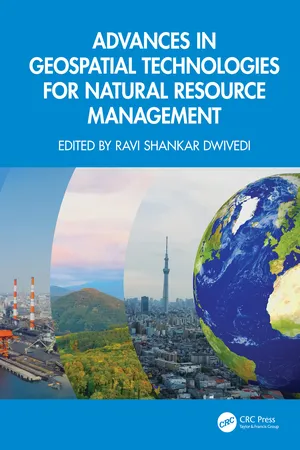
Timely and reliable information on natural resources, regarding their potential and limitations, is a prerequisite for sustainable development. Geospatial technologies offer immense potential in providing such information in a timely and cost-effective manner. Using orbital sensors data in conjunction with airborne and proximal sensors data to generate information on soils and agricultural resources, forests, mineral resources, fossil fuel, wetlands, water resources, and marine resources, this book focuses on the advancements in technologies applicable to managing these resources. It addresses global issues like climate change and land degradation neutrality and introduces spatial data infrastructure (SDI) as a mechanism for sharing geospatial data. This book also provides an in-depth discussion on drones, crowdsourcing, cloud computing, Internet of Things, machine learning, and their applications.
FEATURES
- Contains a comprehensive resource on the latest developments in geospatial technologies and their use in monitoring natural resources, productivity mapping, and modeling
- Explains the geo-computation methods and online algorithm developments
- Includes clear guidance on how best to use geospatial data for various applications
- Discusses case studies from a variety of fields and current trends in the management of natural resources
- Provides future scenarios concerning platforms, sensors, data analysis, and interpretation techniques
This book is written for remote sensing and GIS professionals in environmental institutions and government who are involved in natural resource management projects. Senior undergraduate and graduate-level students in Earth sciences, geography, or environmental management can also use this text for supplementary reading.