The foundations of modern political thought, presumed secular, were laid in conversation with theologically motivated politics and in negotiation with Jewish ideas
Mid-seventeenth-century England was a hotbed in which crucial ideas of modern politics were conceived: Thomas Hobbes presented his social contract; John Selden wrote major treatises which were foundational for modern natural and international law; and England participated in the wave of republicanism that swept over Europe. This was also the period of the English Civil War—which has been portrayed as a "war of religion" and a "revolution of saints"—and was characterized by religious ends and motivations guiding politics and politicians.
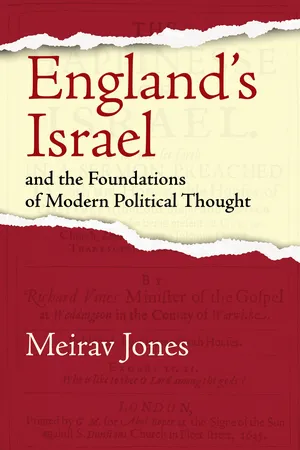
In England's Israel and the Foundations of Modern Political Thought, Meirav Jones proposes that the foundational political theory conceived in this period was significantly related to the theological politics of the time. Through an examination of the language and imagery shared by theorists and saints, Jones finds that, in the twenty-year period between 1640 and1660, when Hobbes, Selden, and their contemporaries published, over 40 percent of all texts published in England contained one or more of the terms "Hebrew," "Israel," "Jerusalem," "Zion," or "Jew." Further, all known works of political theory from the period employed these terms. While preachers in English parliament addressed and understood England as "Israel," foundational theorists of the modern state employed ancient Israel as a political model and explicitly preferred Hebrew over Greek wisdom.
Modern politics did not develop solely from within a conversation among elites, neither was it conceived as a Godless enterprise, even by its most renowned secular architects. Instead, as the book demonstrates, it spoke the language of religiously motivated politics and was conceived in its terms. Ultimately, Jones argues that it was through a sweeping revival of Hebrew in early modern Europe that the foundations of modern politics were laid in conversation with theological politics and in negotiation with Jewish ideas and ideas of the Jews.
- 272 pages
- English
- ePUB (mobile friendly)
- Available on iOS & Android
eBook - ePub
England’s Israel and the Foundations of Modern Political Thought
About this book
Information
Topic
Theology & ReligionSubtopic
British HistoryTable of contents
- Cover
- Series Page
- Title Page
- Copyright
- Contents
- Chapter 1. Introduction
- Chapter 2. England’s Israel
- Chapter 3. Hobbes and the Old Israel
- Chapter 4. Modern Natural Law and Its Judaic Sources
- Chapter 5. English Republicanism Reconsidered
- Chapter 6. Review and Conclusion
- Notes
- Bibliography
- Index
Trusted by 375,005 students
Access to over 1.5 million titles for a fair monthly price.
Study more efficiently using our study tools.
Frequently asked questions
Yes, you can cancel anytime from the Subscription tab in your account settings on the Perlego website. Your subscription will stay active until the end of your current billing period. Learn how to cancel your subscription
No, books cannot be downloaded as external files, such as PDFs, for use outside of Perlego. However, you can download books within the Perlego app for offline reading on mobile or tablet. Learn how to download books offline
Perlego offers two plans: Essential and Complete
- Essential is ideal for learners and professionals who enjoy exploring a wide range of subjects. Access the Essential Library with 800,000+ trusted titles and best-sellers across business, personal growth, and the humanities. Includes unlimited reading time and Standard Read Aloud voice.
- Complete: Perfect for advanced learners and researchers needing full, unrestricted access. Unlock 1.5M+ books across hundreds of subjects, including academic and specialized titles. The Complete Plan also includes advanced features like Premium Read Aloud and Research Assistant.
We are an online textbook subscription service, where you can get access to an entire online library for less than the price of a single book per month. With over 1.5 million books across 990+ topics, we’ve got you covered! Learn about our mission
Look out for the read-aloud symbol on your next book to see if you can listen to it. The read-aloud tool reads text aloud for you, highlighting the text as it is being read. You can pause it, speed it up and slow it down. Learn more about Read Aloud
Yes! You can use the Perlego app on both iOS and Android devices to read anytime, anywhere — even offline. Perfect for commutes or when you’re on the go.
Please note we cannot support devices running on iOS 13 and Android 7 or earlier. Learn more about using the app
Please note we cannot support devices running on iOS 13 and Android 7 or earlier. Learn more about using the app
Yes, you can access England’s Israel and the Foundations of Modern Political Thought by Meirav Jones in PDF and/or ePUB format, as well as other popular books in Theology & Religion & British History. We have over 1.5 million books available in our catalogue for you to explore.