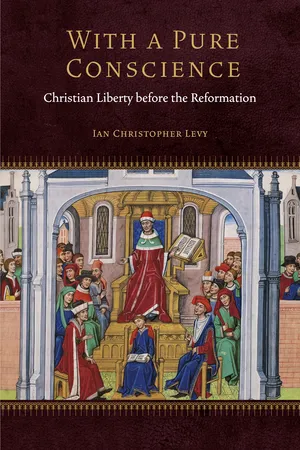
Offers new perspectives on freedom of conscience and religious liberty by tracing their origins to the Middle Ages, thereby challenging the common assumption that these core tenets of modernity were products of the Enlightenment
Deeply committed to the formation of a just and sacred society, medieval theologians and canonists developed sophisticated arguments in defense of religious liberty and freedom of conscience. They did so based upon the conviction that each human person possesses an inalienable right to pursue his or her spiritual vocation and to inquire into the truth, provided that such pursuits were not deemed injurious to the commonweal. For this was an age in which all power, whether secular or sacred, was held to be exercised legitimately only insofar as it served the common good. Within these basic parameters there existed a domain of personal freedom guaranteed by natural and divine law that could not be infringed by either secular or ecclesiastical authority. Theologians and canonists did not countenance blind obedience to reigning powers nor did they permit Christians to stand idle in the face of manifest transgressions of sacred tradition, constitutional order, and fundamental human rights.
Such foundational principles as the sacred domain of conscience, freedom of intellectual inquiry, dissent from unjust authority, and inalienable personal rights had been carefully developed throughout the later Middle Ages, hence from the twelfth through the fifteenth centuries. Contrary to the popular conception, therefore, the West did not need to wait for the Protestant Reformation, or the Enlightenment, for these values to take hold. In fact, the modern West may owe its greatest debt to the Middle Ages. With a Pure Conscience sheds further light on these matters in a variety of contexts, within and without the medieval university walls, and often amid momentous controversies. This was a robust intellectual culture that revered careful analysis and vigorous disputation in its relentless quest to understand and defend the truth as it could be ascertained through both reason and revelation.
With a Pure Conscience: Christian Liberty before the Reformation is available from the Knowledge Unlatched on an open-access basis.