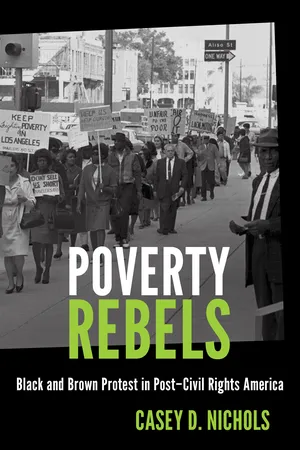
In 1960s Los Angeles, a powerful network within Black and Chicana/o organizations transformed the War on Poverty and Model Cities program. Black and Brown activists worked together and separately to use the US federal government’s War on Poverty as an opportunity to establish programs that would counteract the neglect that led to underfunded schools, inadequate housing, and a lack of community institutions. Casey Nichols examines this diverse group of intentional and unintentional collaborators she calls “poverty rebels,” which included politicians, activists, youth, professionals, community members, and local people.
Poverty rebels leveraged federal antipoverty funding to work around the limited capacity of the Civil Rights Act of 1964 to address the dual impact of race and class in African American and Mexican American communities. They understood that unequal policy had created their urban realities and sought to redefine antipoverty legislation in a way that improved their material lives. Drawing on a wide range of sources, including local and federal government documents, oral histories, and organizational records, Nichols examines vital links between the nation’s social and political spheres. Ultimately, she argues that Black-Brown relations gained greater national significance during the mid-1960s amid important civil rights victories and social policies to address so-called disadvantaged communities. By coming into social and political proximity, African Americans and Mexican Americans constructed a national dialogue about Black-Brown relations that had shared benefits, and that continues to shape policy debates today.
- 202 pages
- English
- ePUB (mobile friendly)
- Available on iOS & Android
eBook - ePub
About this book
Information
Table of contents
- Cover
- Series Page
- Title Page
- Copyright
- Dedication
- Contents
- List of Illustrations
- Acknowledgments
- Introduction: Tracing the Historical Roots of Black-Brown Relations
- Chapter One. Black and Brown Los Angeles
- Chapter Two. Black Noise, Brown Invisibility
- Chapter Three. The Economic Opportunity Generation
- Chapter Four. Black and Brown at the White House
- Chapter Five. Su Lucha Es Mi Lucha (Your Battle Is My Battle)
- Chapter Six. The Magna Carta to Liberate Our Cities: African Americans, Mexican Americans, and the Model Cities Program in Los Angeles
- Epilogue: The War on Poverty’s Legacy in Black and Brown America
- Notes
- Bibliography
- Index
Trusted by 375,005 students
Access to over 1.5 million titles for a fair monthly price.
Study more efficiently using our study tools.
Frequently asked questions
Yes, you can cancel anytime from the Subscription tab in your account settings on the Perlego website. Your subscription will stay active until the end of your current billing period. Learn how to cancel your subscription
No, books cannot be downloaded as external files, such as PDFs, for use outside of Perlego. However, you can download books within the Perlego app for offline reading on mobile or tablet. Learn how to download books offline
Perlego offers two plans: Essential and Complete
- Essential is ideal for learners and professionals who enjoy exploring a wide range of subjects. Access the Essential Library with 800,000+ trusted titles and best-sellers across business, personal growth, and the humanities. Includes unlimited reading time and Standard Read Aloud voice.
- Complete: Perfect for advanced learners and researchers needing full, unrestricted access. Unlock 1.5M+ books across hundreds of subjects, including academic and specialized titles. The Complete Plan also includes advanced features like Premium Read Aloud and Research Assistant.
We are an online textbook subscription service, where you can get access to an entire online library for less than the price of a single book per month. With over 1.5 million books across 990+ topics, we’ve got you covered! Learn about our mission
Look out for the read-aloud symbol on your next book to see if you can listen to it. The read-aloud tool reads text aloud for you, highlighting the text as it is being read. You can pause it, speed it up and slow it down. Learn more about Read Aloud
Yes! You can use the Perlego app on both iOS and Android devices to read anytime, anywhere — even offline. Perfect for commutes or when you’re on the go.
Please note we cannot support devices running on iOS 13 and Android 7 or earlier. Learn more about using the app
Please note we cannot support devices running on iOS 13 and Android 7 or earlier. Learn more about using the app
Yes, you can access Poverty Rebels by Casey D. Nichols in PDF and/or ePUB format, as well as other popular books in Social Sciences & African American Studies. We have over 1.5 million books available in our catalogue for you to explore.