A new interpretation of captivity, human trafficking, and colonization in the seventeenth-century Caribbean
A century before the height of the Atlantic slave trade, early modern racialized slavery emerged through practices of captive-taking and human trafficking in the sixteenth- and seventeenth-century Caribbean. The Predatory Sea offers the first full-length study of this deeply entangled history of captivity and colonialism.
Between 1570 and 1670, a multinational assortment of privately funded ship captains, sailors, merchants, and adventurers engaged in widespread practices of captive-taking and human trafficking. Raids against coastal communities and regional shipping in the Caribbean ensnared multitudes, including free and previously enslaved people of African and Indigenous descent, who found themselves trafficked into slavery away from their communities of belonging. Beginning in the 1570s, their captors established maritime bases on small, strategically located islands throughout the region. Those anchorages served as temporary settlements for northern European traffickers decades before their respective monarchs sanctioned official colonies. Colonization thus started with practices of captive-taking and human trafficking, which remained central to the development of the first English and French colonies in the Caribbean.
Through extensive research in Spanish, French, and English archives in Europe and the Caribbean, Casey Schmitt offers a fresh perspective on how captivity and maritime violence shaped early English, French, and Dutch settlement. Reading across imperial archives, she also reveals the experiences of those ensnared in this trade. Many captives escaped to Spanish population centers, where they testified to officials about what they witnessed in early English, French, and Dutch colonies. Those testimonies informed a series of Spanish attacks on foreign settlements in the Caribbean over the decades leading up to the 1650s. As Schmitt argues, captives were cause and consequence of inter-imperial competition and warfare during this violent century of Caribbean history. This captive economy, as explicated in The Predatory Sea, shaped English and French colonization, inter-imperial competition, and the lived experiences of captives and their captors.
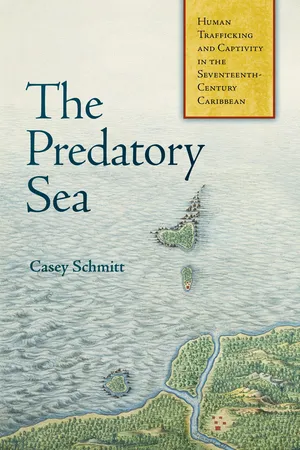
eBook - ePub
The Predatory Sea
Human Trafficking and Captivity in the Seventeenth-Century Caribbean
- 336 pages
- English
- ePUB (mobile friendly)
- Available on iOS & Android
eBook - ePub
About this book
Information
Subtopic
Early Modern HistoryIndex
HistoryTable of contents
- Cover
- Series Page
- Title Page
- Copyright
- Dedication
- Epigraph
- Contents
- Preface
- Introduction
- Chapter 1. “A Sea of Islands”: Cross-Cultural Trade and Captive Slavery
- Chapter 2. “Betwixt Ye Two Rivers”: Human Trafficking and Colonization
- Chapter 3. “They Took Him to Sea”: Captivity and Violence Before Mid-Century
- Chapter 4. “As He Himself Confessed”: Contested Spaces and Serial Displacement
- Chapter 5. “A Trail Would Be Blazed”: Reform, Commercial Competition, and War
- Chapter 6. “Free as Any Children of Adam”: Warfare, Racialized Vulnerability, and the English Invasion of Jamaica
- Conclusion
- Notes
- Index
- Acknowledgments
Trusted by 375,005 students
Access to over 1.5 million titles for a fair monthly price.
Study more efficiently using our study tools.
Frequently asked questions
Yes, you can cancel anytime from the Subscription tab in your account settings on the Perlego website. Your subscription will stay active until the end of your current billing period. Learn how to cancel your subscription
No, books cannot be downloaded as external files, such as PDFs, for use outside of Perlego. However, you can download books within the Perlego app for offline reading on mobile or tablet. Learn how to download books offline
Perlego offers two plans: Essential and Complete
- Essential is ideal for learners and professionals who enjoy exploring a wide range of subjects. Access the Essential Library with 800,000+ trusted titles and best-sellers across business, personal growth, and the humanities. Includes unlimited reading time and Standard Read Aloud voice.
- Complete: Perfect for advanced learners and researchers needing full, unrestricted access. Unlock 1.5M+ books across hundreds of subjects, including academic and specialized titles. The Complete Plan also includes advanced features like Premium Read Aloud and Research Assistant.
We are an online textbook subscription service, where you can get access to an entire online library for less than the price of a single book per month. With over 1.5 million books across 990+ topics, we’ve got you covered! Learn about our mission
Look out for the read-aloud symbol on your next book to see if you can listen to it. The read-aloud tool reads text aloud for you, highlighting the text as it is being read. You can pause it, speed it up and slow it down. Learn more about Read Aloud
Yes! You can use the Perlego app on both iOS and Android devices to read anytime, anywhere — even offline. Perfect for commutes or when you’re on the go.
Please note we cannot support devices running on iOS 13 and Android 7 or earlier. Learn more about using the app
Please note we cannot support devices running on iOS 13 and Android 7 or earlier. Learn more about using the app
Yes, you can access The Predatory Sea by Casey Schmitt in PDF and/or ePUB format, as well as other popular books in History & Early Modern History. We have over 1.5 million books available in our catalogue for you to explore.