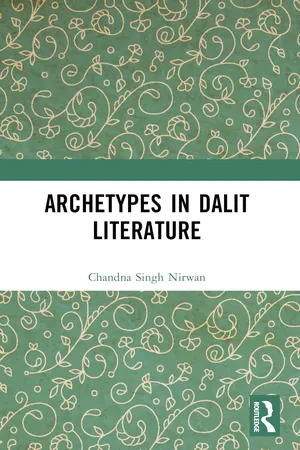
Archetypes in Dalit Literature examines the role of the multitudinous archetypes and myths in understanding the evolution of the psyche and consciousness of the Parayar Dalit community based out of Tamil Nadu, India. This book also examines the other Dalit communities like Bhangis, Chuhras and Madigas through the lens of Archetypal criticism. This is a nuanced take on Dalit Studies where Western thought and theory have been applied to the colossal work of a Tamil Dalit writer, Bama and others (Mulk Raj Anand, Omprakash Valmiki, Sharankumar Limbale and Perumal Murugan) to comprehend the community archetypal characters, setting, myths, rituals, and language. A detailed analysis of the Jungian archetypes of Rebirth, Mother, Spirit and Trickster has helped in acquiring an understanding of the so-called lower caste, their circumstances, their life and experiences. Among the seminal works on myth criticism are Joseph Campbell's 'Monomyth' and Vladimir Propp's 'Functions'. One of Bama's works, Vanmam (2008) largely adheres to these structures which makes it a good example of fiction based on reality and thereby, also making it at par with the mainstream Indian Writing in English. Chandna has also analyzed the significance of community myths, stories, and folklore using the concept of implicit mythology. This book also studies the Dalit language as a special case and unfolds various meanings about the culture, community, and people in context. An important finding is that the language of marginalization is very much a reality. Bama's narratives are true representations of the journey of the Parayar Dalit identity formation and the changes it has undergone over time. The study of the different aspects of the lives, ideologies, and culture of the marginalized section of Indian society as represented by these writers in their works has enhanced the understanding of their significant role and contribution to Indian society which may not have, over time been acknowledged, yet undeniably needs to be appreciated and celebrated.
- 240 pages
- English
- ePUB (mobile friendly)
- Available on iOS & Android
eBook - ePub
Archetypes in Dalit Literature
About this book
Information
Table of contents
- Cover
- Half Title
- Title Page
- Copyright Page
- Table of Contents
- Acknowledgements
- 1 Introduction
- 2 Archetypes in Dalit Writings: Bama and Others
- 3 Dalit Writings: A Structural Analysis
- 4 Social Inclusivity/Exclusivity of the Dalit Communities
- 5 The Language of Marginalisation in Dalit Narratives
- 6 Conclusion
- Interview
- Notes
- Bibliography
- Appendix
- Index
Trusted by 375,005 students
Access to over 1.5 million titles for a fair monthly price.
Study more efficiently using our study tools.
Frequently asked questions
Yes, you can cancel anytime from the Subscription tab in your account settings on the Perlego website. Your subscription will stay active until the end of your current billing period. Learn how to cancel your subscription
No, books cannot be downloaded as external files, such as PDFs, for use outside of Perlego. However, you can download books within the Perlego app for offline reading on mobile or tablet. Learn how to download books offline
Perlego offers two plans: Essential and Complete
- Essential is ideal for learners and professionals who enjoy exploring a wide range of subjects. Access the Essential Library with 800,000+ trusted titles and best-sellers across business, personal growth, and the humanities. Includes unlimited reading time and Standard Read Aloud voice.
- Complete: Perfect for advanced learners and researchers needing full, unrestricted access. Unlock 1.5M+ books across hundreds of subjects, including academic and specialized titles. The Complete Plan also includes advanced features like Premium Read Aloud and Research Assistant.
We are an online textbook subscription service, where you can get access to an entire online library for less than the price of a single book per month. With over 1.5 million books across 990+ topics, we’ve got you covered! Learn about our mission
Look out for the read-aloud symbol on your next book to see if you can listen to it. The read-aloud tool reads text aloud for you, highlighting the text as it is being read. You can pause it, speed it up and slow it down. Learn more about Read Aloud
Yes! You can use the Perlego app on both iOS and Android devices to read anytime, anywhere — even offline. Perfect for commutes or when you’re on the go.
Please note we cannot support devices running on iOS 13 and Android 7 or earlier. Learn more about using the app
Please note we cannot support devices running on iOS 13 and Android 7 or earlier. Learn more about using the app
Yes, you can access Archetypes in Dalit Literature by Chandna Singh Nirwan in PDF and/or ePUB format, as well as other popular books in Literature & Asian Literary Criticism. We have over 1.5 million books available in our catalogue for you to explore.