The more than 90 refereed papers in this volume continue a series of biannual benchmarks for technologies that maximize energy conversion while minimizing undesirable emissions. Covering the entire range of industrial and transport combustion as well as strategies for energy research and development, these state-of-the-art will be indispensable to mechanical and chemical engineers in academia and industry and technical personnel in military, energy and environmental government agencies.
eBook - ePub
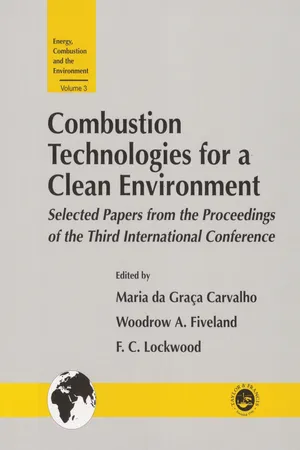
Combustion Technology for a Clean Environment
Selected Papers for the Proceedings of the Third International Conference, Lisbon, Portugal, July 3-6, 1995
- 960 pages
- English
- ePUB (mobile friendly)
- Available on iOS & Android
eBook - ePub
Combustion Technology for a Clean Environment
Selected Papers for the Proceedings of the Third International Conference, Lisbon, Portugal, July 3-6, 1995
About this book
Information
Table of contents
- Cover
- Half Title
- Energy, Combustion and the Environment
- Title Page
- Copyright Page
- Contents
- Preface
- Advisory Committee
- Sponsoring Organizations
- Section 1 — Strategies: Now and in the Future
- Application of Advanced Technology to Meet Worldwide Environmental Regulations
- Criteria and Alternatives for Development of Coal-Based Electricity Generation Technologies
- Section 2 — Gas Combustion
- Low NOx Burners for Boilers, Furnaces and Gas Turbines; Drive towards the Lower Bounds of NOx Emissions
- The Effects of CH3C1 and CH2C12 Addition on a Low-Pressure Stoichiometric CH4/O2/N2 Premixed Laminar Flat Flame Experimental and Modeling Studies
- Combustion Process of Natural Gas in a Rapid Compression Combustor
- NOx Formation in Counter-Flow Opposed-Jet Diffusion CH4/Air Flames
- Modelling of NOx Formation in Turbulent H2 Diffusion Flames
- Low NOx Blue Flame Coanda Burner
- Presumed PDF for Modelling of NO Formation in Methane Combustion
- The Influence of the Temperature Fluctuations Variance on NO Predictions for a Gas Flame
- Evaluation of the Effectiveness of a NOx Post Processor in Predicting the Performance of Natural Gas Fired Cyclone and Swirl Combustors
- A Non-Orthogonal Combustion Model for Natural Gas Flames
- Conversion of Power Station Combustor from Coal to Gas Firing
- Section 3 — Oil Combustion
- Numerical Simulation of the Oil Combustion Process in a 100 KW Serially Produced Low NOx Combustion System
- NOx Emission Rates from Oxy-Fuel Oil Flames
- Optimization of Fuel Prevaporization on Porous Surfaces for Low-NOx-Combustion
- Cleaner Combustion with Water-in-Fuel Emulsion
- Parametric Investigation of Extraction of El-Lajjun Oil Shale
- Emission Studies on Combustion of Gasolines in Low Pressure Premixed Laminar Flames
- Influence of Oxidant Excess on the Emission Rates of Nitrogen Oxides and Particulate Material from Power Boilers Burning Ultra-Viscous Oils
- Section 4 — Coal Combustion
- Emissions from Slow Pyrolysis of Solid Fuels Studied by GC/MS in a Miniature Reactor
- Sulfation Propensity of Coal Ashes and Instability of Calcium and Magnesium Sulfates at High Temperatures
- Emissions of Nitrogen Oxides During the Combustion of Chars Under Elevated Pressure in a Mixture of O2 and CO2
- Hydrogen Peroxide Injection — A Novel Technology for Multiple Air Pollutant Emissions Removal
- Influence of the Stoichiometric Ratio in the Reburning Zone on the Concentration of Different Species
- Pyrolysis Gas of Biomass and Coal as a NOx Reductive in a Coal Fired Test Facility
- Influence of Operational Parameters on the Results of Reburning in Coal Combustion
- A Fast-Chemistry Model for Coal-Gas Reburning
- Scale-Up Procedure from Pilot Plant Tests to Full-Size Power Plant Results: Experimentation vs. Mathematical Modelling
- Effect of Scale on Combustion and NOX Formation Characteristics in Coal-Fired Furnaces
- Studies and Development of Non-Slagging Cyclone Coal Combustors in China
- Numerical Simulation of Advanced Coal-Fired Combustion Systems with In-Furnace NOx Control Technologies
- A Two-Fluid Model for Simulating Turbulent Gas-Particle Flows, Coal Combustion and NOx Formation in an Oxygen-Coal Combustor
- A Computationally Economical Simulation of Small Particle Deposition in a Turbulent Duct Flow
- The Use of Thermodynamic Computation Packages to Predict the Formation of Organic Species During the Utilisation of Coal
- Section 5 — Wood Combustion
- Combined Combustion of Coal and Biomass in Pulverized Fuel and Fluidized Bed Systems
- Using Upper and Lower Control Limits to Regulate Hazardous Air Emissions from Wood-Fired Boilers
- Study of a Biomass Cyclone Combustor (Numerical and Experimental Results)
- Section 6 — Combustion of Alternative Fuels
- Techno-Economic Comparison of Different Processes for Fuel Production Based on Sewage Sludge
- Briquettes for Pollution Control from Residential and Small Industrial Sources
- Burning Rubber: The Controlling Surface Process of Polybutadiene under Combustion-like Conditions
- Section 7 — Co-Combustion and Co-Gasification
- Biomass Co-Combustion for the Pollutant Control in Pulverized Coal Units
- Co-Combustion of Biomass and Coal in a Pressurized Bubbling Fluidized Bed Combustor
- The Co-Firing of Pulverized Bituminous Coals with Straw, Waste Paper and Municipal Sewage Sludge
- Combined Gasification of Coal and Straw
- Coal/Biomass Co-gasification and High Temperature Gas Cleaning
- Section 8 — Catalytic Combustion
- Catalytic Combustion: New Catalysts for New Technologies
- ZrO2-Based Catalysts in Methane Oxidation with Minimum NOx Production
- Fe-Cr-Al Alloy Monolithic Catalysts for Total Oxidation of Alkane Fuels
- The Development of a Catalytic Combustor for Natural Gas
- Section 9 — No, So, Soot Fundamentals
- Kinetic Behaviour of Desulfurization Processes at Medium Temperature (350°C) Using Calcium Hydroxide
- Catalytic Combustion of Methane Soot
- Carbonization Rate of Soot Precursor Particles
- Formation of NO in One- and Two-Dimensional Laminar Premixed Methane Air Rames Using Complex Reaction Schemes
- On the Construction of Reduced Mechanisms — A Two Step Global Mechanism for Wet CO Flames
- Numerical Simulation of Selective Non-Catalytic Reduction of NO in Exhaust Gas with Urea Particle
- Section 10 — Advanced Diagnostics
- 2D-Laser Temperature and NO Concentration Measurements in a Domestic Natural Gas Burner
- Pyrometric Particle Temperature Measurements in a Pressurized Fluidized Bed Gasification Reactor
- A New Sensor System for Industrial Combustion Monitoring and Control Using UV Emission Spectroscopy and Tomography
- Section 11 — Burners
- Heat-Recirculating Burners: Principles and Some Recent Developments
- Performance and Influence of Air-Staging on a Direct Fired Integral Bed Regenerative Burner
- NO Emission of Ceramic Foam Surface Gas Burners in the Radiant Mode
- Combustion in a Porous Medium — Advances and Applications
- Methane Emissions from Natural Gas Fired Domestic Boilers and Space Heaters
- Low NOx Natural Gas Burner for Domestic and Semi-Industrial Appliances: Investigation on an Advanced Purely Aerodynamic NOx Reduction Technology
- Combustion Modeling of Coal-Fired, Aerodynamically Air-Staged Burners
- Prediction of NO Emissions from a Swirling Coal Flame
- Optimization of a Pulverized Brown Coal Burner
- Section 12 — Fluidised Bed Combustion
- The Use of Thermodynamic Computation Packages to Predict the Reactions Occuring During Combustion and Gasification in Fluidised Beds
- Modelling of Desulfurization Behaviour in Circulating Fluidized Beds (CFB)
- On the Three-Dimensional Simulation of Circulating Atmospheric Fluidized Bed Combustors
- Fluidized Bed Combustion of Gaseous Fuels
- Biomass Fluidized Bed Devolatilization and Gasification Research in the State University of Campinas
- Section 13 — Incineration
- Compact Waste Incinerator Based on Vortex Combustion
- Waste Incineration Plant Modeling Using a Parallelized Domain Decomposition Method with Locally Refined Subgrids
- Explosive Incineration in a Fluidised Bed
- Feasibility of Catalytic Incineration for Coating Industries
- Fly Ash as Sorbent for Adsorption of Mercuric Chloride
- The Effects of Extraneous Metal Oxides and Chlorides of the Partitioning of Toxic Metals in the Flames of a Pulverised Waste Fuel
- Numerical Modelling of a Municipal Solid-Waste Incinerator
- Section 14 — Engines
- Exhaust Emissions from Vehicles; Regulations and Methods of Fulfilment
- Diesel Engine Drive Using an Oxygen-Enricher
- Emission and Combustion Characteristics of a Methanol/Dimethyl Ether Dual-Fuelled Compression Ignition Engine
- Combustion Bomb Experiments for Natural Gas-Diesel Oil Combustion near the Ignition Limits
- Section 15 — Advanced Cycles
- The Pressurised Gasifier in the Air Blown Gasification Cycle
- A Comparison of Electricity Generation from Combustion and IGCC Plants using Wood Feedstock
- Section 16 — Gas Clean Up
- What Overall Nitrogen Kinetics Can Teach us about Optimizing Catalytic NO Abatement Reactors
- NOx-Reduction in Diesel Exhaust Gas with Urea and Selective Catalytic Reduction
- Abatement of S02 and NOx from Gas Streams by Using Activated Carbon
- Transfer Mechanisms in the Desulphurization of Rue Gas by Seawater
- Section 17 — Control Strategy
- Power Plant Boiler Expert System
- The Application of Life Cycle Assessment as an Environmental Decision Making Tool in the Power Sector
- An Automatic Control System for Clean Coal Combustion on a Chain-Grate Stoker
- An Alternative Approach to the Control of Industrial Combustors
- Section 18 — Clean Combustion in Process Industries
- Numerical Study of Petroleum Coke Fired Cement Kiln Flames
- Pilkington "3R" Technology for NOx Control in Glass Furnaces
- Low-NOx Combustion Techniques for Glass Melting Furnaces
- Environment Changes Using Pulverized Coal instead of Certain Coke Share for Ironmaking
Trusted by 375,005 students
Access to over 1.5 million titles for a fair monthly price.
Study more efficiently using our study tools.
Frequently asked questions
Yes, you can cancel anytime from the Subscription tab in your account settings on the Perlego website. Your subscription will stay active until the end of your current billing period. Learn how to cancel your subscription
No, books cannot be downloaded as external files, such as PDFs, for use outside of Perlego. However, you can download books within the Perlego app for offline reading on mobile or tablet. Learn how to download books offline
Perlego offers two plans: Essential and Complete
- Essential is ideal for learners and professionals who enjoy exploring a wide range of subjects. Access the Essential Library with 800,000+ trusted titles and best-sellers across business, personal growth, and the humanities. Includes unlimited reading time and Standard Read Aloud voice.
- Complete: Perfect for advanced learners and researchers needing full, unrestricted access. Unlock 1.5M+ books across hundreds of subjects, including academic and specialized titles. The Complete Plan also includes advanced features like Premium Read Aloud and Research Assistant.
We are an online textbook subscription service, where you can get access to an entire online library for less than the price of a single book per month. With over 1.5 million books across 990+ topics, we’ve got you covered! Learn about our mission
Look out for the read-aloud symbol on your next book to see if you can listen to it. The read-aloud tool reads text aloud for you, highlighting the text as it is being read. You can pause it, speed it up and slow it down. Learn more about Read Aloud
Yes! You can use the Perlego app on both iOS and Android devices to read anytime, anywhere — even offline. Perfect for commutes or when you’re on the go.
Please note we cannot support devices running on iOS 13 and Android 7 or earlier. Learn more about using the app
Please note we cannot support devices running on iOS 13 and Android 7 or earlier. Learn more about using the app
Yes, you can access Combustion Technology for a Clean Environment by Maria Carvalho in PDF and/or ePUB format, as well as other popular books in Technology & Engineering & Environmental Management. We have over 1.5 million books available in our catalogue for you to explore.