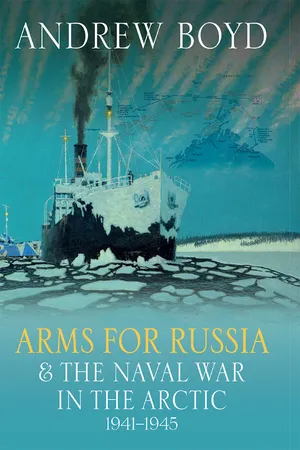
This major new work fundamentally reassesses the operations by the Western allies to deliver war supplies to Russia via the Arctic sea route between 1941 and 1945. It explores the motives underpinning Western aid, its real impact on the Soviet war effort, and its influence on wider Allied and German strategy as the war developed. It brings to life key participants, political and military, describes the interaction of intelligence with high policy and tactics, and brings a fresh perspective to key events, including the notorious convoy PQ 17. The book disputes the long-standing view that aid to Russia was essentially discretionary, lacking military rationale and undertaken primarily to meet political objectives, with only a minor impact on Soviet war potential. It shows that aid was always grounded in strategic necessity, with the Arctic supply route a constant preoccupation of British and American leaders, absorbing perhaps twenty per cent of Royal Navy resources after 1941 and a significant share of Allied merchant shipping badly needed in other theaters. The Soviet claim, determinedly promoted through the Cold War, that aid was marginal, still influences attitudes in Vladimir Putin's Russia and contemporary Western opinion. It even resonates through the present war in Ukraine. Andrew Boyd demonstrates that in reality, Western aid through the Arctic was a critical multiplier of Soviet military power throughout the war and perhaps even enabled Russia's very survival in 1942; and he makes plain that the British contribution to the aid effort was greater than generally acknowledged. The book also emphasises that the Arctic conflict was not framed solely by the supply convoys, important though they were. British, German and Russian operations in a theater – defined by Adolph Hitler in early 1942 as the 'zone of destiny' – were shaped by other perceived opportunities and threats. For instance, Germany concentrated its fleet in Norway to forestall a potential British attack while attempting land offensives to cut Russia's links with its northern ports. It also had vital raw materials to protect. Britain explored potential operations with Russia to dislodge Germany from the Arctic coast and sever her access to important resources. Elegantly written written and incorporating many new perspectives on the Arctic theater, this new work should find a place on the shelves of every historian, scholar and enthusiast whose interests extend to the Russian dimension of the Second World War.
- 576 pages
- English
- ePUB (mobile friendly)
- Available on iOS & Android
eBook - ePub
Arms for Russia & The Naval War in the Arctic, 1941–1945
About this book
Information
Edition
0Subtopic
Military & Maritime HistoryTable of contents
- Cover
- Title
- Copyright
- Contents
- List of Maps
- List of Illustrations
- Foreword
- Acknowledgements
- Abbreviations
- Glossary of Codenames
- Introduction
- Prelude: August 1941: Churchill and Roosevelt at Placentia Bay
- 1 The Royal Navy in Autumn 1941: Brightening Prospects?
- 2 arbarossa and the Reluctant Opening of an Arctic Theatre
- 3 The Case for Helping Russia: Ends, Ways and Means
- 4 The First Arctic Convoys and Their Impact
- 5 German Countermeasures
- 6 The Beginning of German Combined Arms Attacks
- 7 PQ 17: The Germans Seek a Decisive Victory
- 8 PQ 17: Catastrophe and Aftermath
- 9 Recovery: PQ 18 and the Impact of Torch
- 10 The Battle of the Barents Sea and its Impact
- 11 The Destruction of the German Battlefleet
- 12 Last Convoys and the Final Stand of the Kriegsmarine
- Reflections
- Appendix 1: Arctic Convoys Summary
- Appendix 2: Arctic Aid Deliveries
- Notes
- Bibliography
- Plates
Trusted by 375,005 students
Access to over 1.5 million titles for a fair monthly price.
Study more efficiently using our study tools.
Frequently asked questions
Yes, you can cancel anytime from the Subscription tab in your account settings on the Perlego website. Your subscription will stay active until the end of your current billing period. Learn how to cancel your subscription
No, books cannot be downloaded as external files, such as PDFs, for use outside of Perlego. However, you can download books within the Perlego app for offline reading on mobile or tablet. Learn how to download books offline
Perlego offers two plans: Essential and Complete
- Essential is ideal for learners and professionals who enjoy exploring a wide range of subjects. Access the Essential Library with 800,000+ trusted titles and best-sellers across business, personal growth, and the humanities. Includes unlimited reading time and Standard Read Aloud voice.
- Complete: Perfect for advanced learners and researchers needing full, unrestricted access. Unlock 1.5M+ books across hundreds of subjects, including academic and specialized titles. The Complete Plan also includes advanced features like Premium Read Aloud and Research Assistant.
We are an online textbook subscription service, where you can get access to an entire online library for less than the price of a single book per month. With over 1.5 million books across 990+ topics, we’ve got you covered! Learn about our mission
Look out for the read-aloud symbol on your next book to see if you can listen to it. The read-aloud tool reads text aloud for you, highlighting the text as it is being read. You can pause it, speed it up and slow it down. Learn more about Read Aloud
Yes! You can use the Perlego app on both iOS and Android devices to read anytime, anywhere — even offline. Perfect for commutes or when you’re on the go.
Please note we cannot support devices running on iOS 13 and Android 7 or earlier. Learn more about using the app
Please note we cannot support devices running on iOS 13 and Android 7 or earlier. Learn more about using the app
Yes, you can access Arms for Russia & The Naval War in the Arctic, 1941–1945 by Andrew Boyd in PDF and/or ePUB format. We have over 1.5 million books available in our catalogue for you to explore.