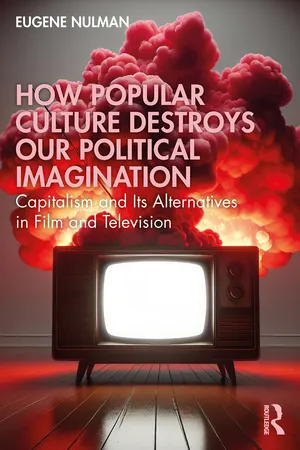
How Popular Culture Destroys Our Political Imagination
eBook - ePub

How Popular Culture Destroys Our Political Imagination

Capitalism and Its Alternatives in Film and Television

  1. 268 pages
  2. English
  3. ePUB (mobile friendly)
  4. Available on iOS & Android
eBook - ePub

How Popular Culture Destroys Our Political Imagination

Capitalism and Its Alternatives in Film and Television

About this book

How Popular Culture Destroys Our Political Imagination: Capitalism and its Alternatives in Film and Television explores the representations of capitalism, the state, and their alternatives in popular screen media texts.

Acknowledging the problems that stem systemically from capitalism and the state, this book investigates an often-overlooked reason for why society struggles to imagine alternative economic and political systems in our neoliberal age: popular culture. The book analyzes 455 screen media texts in search of critiques and alternative representations of these systems and demonstrates the ways in which film and television shape the way we collectively see the world and imagine our political futures. It suggests that popular culture is the answer to the question of why it is easier to imagine the end of the world than the end of capitalism.

Contributing to the areas of sociology, media studies, and utopian studies, this book provides insights into the topic of popular culture and politics in a theoretically informed and entertaining manner. The book will be useful to both students and scholars interested in these topics, as well as activists and organizers seeking to make the world a better place.

Frequently asked questions

Yes, you can cancel anytime from the Subscription tab in your account settings on the Perlego website. Your subscription will stay active until the end of your current billing period. Learn how to cancel your subscription.
No, books cannot be downloaded as external files, such as PDFs, for use outside of Perlego. However, you can download books within the Perlego app for offline reading on mobile or tablet. Learn more here.
Perlego offers two plans: Essential and Complete
  • Essential is ideal for learners and professionals who enjoy exploring a wide range of subjects. Access the Essential Library with 800,000+ trusted titles and best-sellers across business, personal growth, and the humanities. Includes unlimited reading time and Standard Read Aloud voice.
  • Complete: Perfect for advanced learners and researchers needing full, unrestricted access. Unlock 1.4M+ books across hundreds of subjects, including academic and specialized titles. The Complete Plan also includes advanced features like Premium Read Aloud and Research Assistant.
Both plans are available with monthly, semester, or annual billing cycles.
We are an online textbook subscription service, where you can get access to an entire online library for less than the price of a single book per month. With over 1 million books across 1000+ topics, we’ve got you covered! Learn more here.
Look out for the read-aloud symbol on your next book to see if you can listen to it. The read-aloud tool reads text aloud for you, highlighting the text as it is being read. You can pause it, speed it up and slow it down. Learn more here.
Yes! You can use the Perlego app on both iOS or Android devices to read anytime, anywhere — even offline. Perfect for commutes or when you’re on the go.
Please note we cannot support devices running on iOS 13 and Android 7 or earlier. Learn more about using the app.
Yes, you can access How Popular Culture Destroys Our Political Imagination by Eugene Nulman in PDF and/or ePUB format, as well as other popular books in Social Sciences & Media Studies. We have over one million books available in our catalogue for you to explore.

Information

Table of contents

  1. Cover
  2. Half-Title Page
  3. Title Page
  4. Copyright Page
  5. Dedication
  6. Table of Contents
  7. List of Figures
  8. List of Tables
  9. Acknowledgments
  10. Introduction
  11. 1 Neoliberalism, TINA, and the Titanic Effects
  12. 2 Research Methods
  13. 3 Eight Limited Critiques of Capitalism and the State: Mapping the Terrain
  14. 4 Representations of Evil: A Cinematic Anthropology of Villains
  15. 5 Structural Critiques of Capitalism in Film and Television: Mr. Moneybags and the Hidden Abode
  16. 6 Representations of Crises, Colonialism, and Consumerism: Fat Cats, Starving Dogs, and Tulip Bulbs
  17. 7 Transferable Radicalness: Alternative Lifestyles in Film and Television
  18. 8 Radical Resistance in The Lego Movie: The Building Blocks of Utopia
  19. 9 Utopian Conclusions: Yesterday, Today, and Tomorrowland
  20. Appendix: Films/Television Programs Analyzed
  21. Index