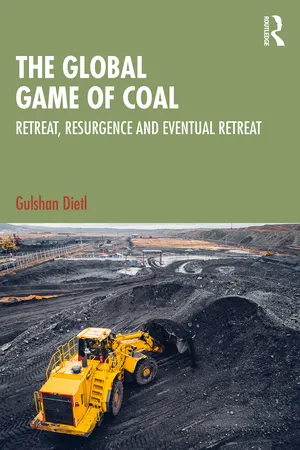
The Global Game of Coal
eBook - ePub

The Global Game of Coal

Retreat, Resurgence and Eventual Retreat

  1. 288 pages
  2. English
  3. ePUB (mobile friendly)
  4. Available on iOS & Android
eBook - ePub

The Global Game of Coal

Retreat, Resurgence and Eventual Retreat

About this book

Coal occupies a large share in the global energy basket. This book explores 'coal game' within the context of shifting energy geopolitics, the 'resource war' and the debates over climate change and energy security.

Politics is a prime arena of game playing. Collaboration, competition, confrontation and their combinations are ingredients in bilateral and multilateral dealings. The book deciphers the interactions within the coal world by resorting to the time-tested term 'global game.' Joe Manchin in the US, Vladimir Putin in Russia, Scott Morrison in Australia and Gautam Adani in Australia and India have been accomplished players in the game of coal. The book looks at coal assets and policies of major coal exporters and importers like the USA, Russia, India, Australia, and China and provides insights into the fierce contestations involved both in local and global politics and commerce over coal, climate and security. The author discusses the role coal has played in the industrialisation of nations, prescriptions to the problem of coal-use and varied scenarios portraying its future.

The third volume in a trilogy on the use of fossil fuels, this book on coal will be of great interest to students and researchers of energy studies, international relations, environment and climate change, energy and geopolitics, security and strategic studies. It will also be useful to policymakers, legislators and environmentalists.

Frequently asked questions

Yes, you can cancel anytime from the Subscription tab in your account settings on the Perlego website. Your subscription will stay active until the end of your current billing period. Learn how to cancel your subscription.
No, books cannot be downloaded as external files, such as PDFs, for use outside of Perlego. However, you can download books within the Perlego app for offline reading on mobile or tablet. Learn more here.
Perlego offers two plans: Essential and Complete
  • Essential is ideal for learners and professionals who enjoy exploring a wide range of subjects. Access the Essential Library with 800,000+ trusted titles and best-sellers across business, personal growth, and the humanities. Includes unlimited reading time and Standard Read Aloud voice.
  • Complete: Perfect for advanced learners and researchers needing full, unrestricted access. Unlock 1.4M+ books across hundreds of subjects, including academic and specialized titles. The Complete Plan also includes advanced features like Premium Read Aloud and Research Assistant.
Both plans are available with monthly, semester, or annual billing cycles.
We are an online textbook subscription service, where you can get access to an entire online library for less than the price of a single book per month. With over 1 million books across 1000+ topics, we’ve got you covered! Learn more here.
Look out for the read-aloud symbol on your next book to see if you can listen to it. The read-aloud tool reads text aloud for you, highlighting the text as it is being read. You can pause it, speed it up and slow it down. Learn more here.
Yes! You can use the Perlego app on both iOS or Android devices to read anytime, anywhere — even offline. Perfect for commutes or when you’re on the go.
Please note we cannot support devices running on iOS 13 and Android 7 or earlier. Learn more about using the app.
Yes, you can access The Global Game of Coal by Gulshan Dietl in PDF and/or ePUB format, as well as other popular books in Politics & International Relations & Sustainable Development. We have over one million books available in our catalogue for you to explore.

Table of contents

  1. Cover
  2. Half-Title
  3. Title
  4. Copyright
  5. Contents
  6. Abbreviations
  7. Prologue
  8. 1 Coal and Coal Miners
  9. PART I Coal Exporters
  10. PART II Coal Importers
  11. PART III Consequences and Conclusions
  12. Bibliography
  13. Index