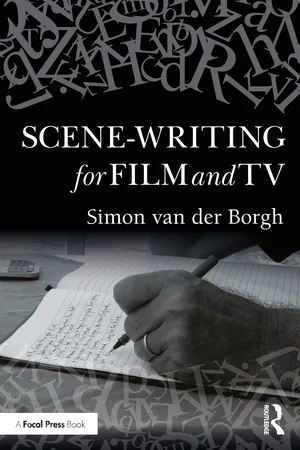
Focusing on an integral aspect of screenplays, this book takes students and writers at all levels through the process of understanding and writing better scenes. It interrogates the functions of a scene and how writers can then apply this knowledge to their own film and television scripts.
Author Simon van der Borgh familiarises the screenwriter with the fundamental aspects of a scene, looking at what a scene is, the characters involved, the action depicted, dialogue, setting, and style. Featuring original scenes which show the practice of scene-writing and the application of ideas and approaches alongside in-depth analysis and critique, the book explores the process and approach to scene-writing and how to learn and improve methods of telling dynamic, engaging and moving stories of diverse types and formats on screen. With a strong focus on practice-based advice, the book includes exercises at every step to enable writers to build on and extend their knowledge and skills with confidence and clarity chapter by chapter.
Exploring the film and TV scene with its different types, forms, and functions, it is the ideal book for aspiring screenwriters and students of screenwriting and filmmaking at all levels, as well as directors, producers and actors looking to better understand the contextual and sub-textual motivations intended by the writer.
- 300 pages
- English
- ePUB (mobile friendly)
- Available on iOS & Android
eBook - ePub
Scene-writing for Film and TV
About this book
Information
Table of contents
- Cover
- Half Title
- Title
- Copyright
- Contents
- Acknowledgements
- Introduction
- 1 Approach: What Is a Scene?
- 2 Character: Whose Scene Is It? Who Is in the Scene and Why?
- 3 Action: What Is the Scene About? What Do We See Happening in the Scene and Why?
- 4 Dialogue: What Are Your Characters Trying to Say?
- 5 The Setting: The Arena Where and When the Action Is Located at a Particular Point in the Story
- 6 Formatting and Layout: What Should a Scene Look Like on the Page?
- 7 Style: What Does the Scene Look, Feel, Sound Like?
- 8 Theme: What’s Your Scene Really About?
- 9 The Sequence: How Do We Join It All Together?
- 10 Recap and Conclusion: Why Isn’t This Scene Working? How Can I Make It Work Better?
- Appendix A
- Appendix B
- Appendix C
- Appendix D
- Bibliography
- Index
Trusted by 375,005 students
Access to over 1.5 million titles for a fair monthly price.
Study more efficiently using our study tools.
Frequently asked questions
Yes, you can cancel anytime from the Subscription tab in your account settings on the Perlego website. Your subscription will stay active until the end of your current billing period. Learn how to cancel your subscription
No, books cannot be downloaded as external files, such as PDFs, for use outside of Perlego. However, you can download books within the Perlego app for offline reading on mobile or tablet. Learn how to download books offline
Perlego offers two plans: Essential and Complete
- Essential is ideal for learners and professionals who enjoy exploring a wide range of subjects. Access the Essential Library with 800,000+ trusted titles and best-sellers across business, personal growth, and the humanities. Includes unlimited reading time and Standard Read Aloud voice.
- Complete: Perfect for advanced learners and researchers needing full, unrestricted access. Unlock 1.5M+ books across hundreds of subjects, including academic and specialized titles. The Complete Plan also includes advanced features like Premium Read Aloud and Research Assistant.
We are an online textbook subscription service, where you can get access to an entire online library for less than the price of a single book per month. With over 1.5 million books across 990+ topics, we’ve got you covered! Learn about our mission
Look out for the read-aloud symbol on your next book to see if you can listen to it. The read-aloud tool reads text aloud for you, highlighting the text as it is being read. You can pause it, speed it up and slow it down. Learn more about Read Aloud
Yes! You can use the Perlego app on both iOS and Android devices to read anytime, anywhere — even offline. Perfect for commutes or when you’re on the go.
Please note we cannot support devices running on iOS 13 and Android 7 or earlier. Learn more about using the app
Please note we cannot support devices running on iOS 13 and Android 7 or earlier. Learn more about using the app
Yes, you can access Scene-writing for Film and TV by Simon van der Borgh in PDF and/or ePUB format, as well as other popular books in Media & Performing Arts & Film Screenwriting. We have over 1.5 million books available in our catalogue for you to explore.