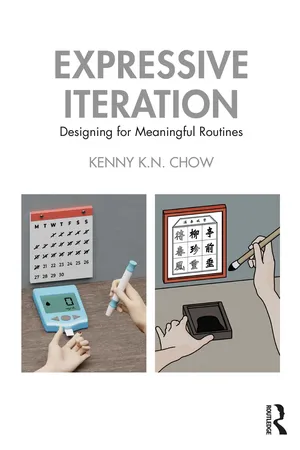
A ground-breaking guide to thinking about how routine activities can be designed and innovated to develop narrative meaning and a sense of purpose.
Iteration is an integral part of daily routines, such as sleep-wake cycles, commuting, workouts, chores, or practising an instrument. While many iterations just monotonously repeat, others can lead to progression or evolution. With subtle variations among iterations, we can create meaning out of repetitive acts, forging narratives from them and thus making them meaningful to us. Chow draws on rhetoric, psychology, narratology, and design-thinking to show both in theory and in practice how we can innovate the design of mundane and routine activities to give them meaning and expression. He does so by examining Asian and European-originated examples, across a range of domains including visual arts, literature, digital art, video games, and mobile applications.
A must-read for designers and enthusiasts looking for ways to innovate across all domains and media and transform tedious repetitive activities into acts of intention.