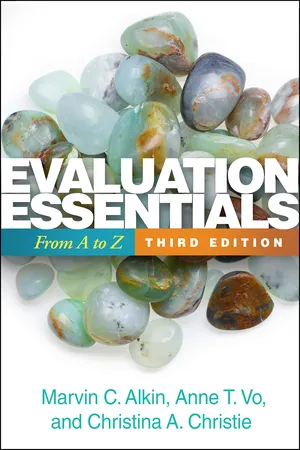
Beloved for its conversational style and reliable advice, this text is now in a revised and updated third edition, reflecting key developments in evaluation. It includes expanded coverage of equity and social justice issues, values and cost analysis, visualizing qualitative data with software, and more. Twenty-six concise chapters, or "sessions, " give students, applied researchers, and program administrators a solid foundation for conducting or using evaluations. Covering both quantitative and qualitative methods, the book emphasizes fostering evaluation use. It shows how to build collaborative relationships with users; formulate answerable evaluation questions; deal with contingencies that might alter the traditional sequence of an evaluation; and collect, analyze, and report data. Student-friendly features throughout the sessions include titles written as questions, bulleted recaps, "Thinking Ahead" and "Next Steps" pointers, cautionary notes, and annotated suggestions for further reading. An in-depth case study provides the basis for end-of-session practice exercises. New to This Edition
*New sessions on context-sensitive evaluation, including the organizational, sociopolitical, and community contexts of a program.
*New or expanded discussions of timely topics: identifying evaluation decision makers, analyzing program costs, coding and visualizing qualitative data with software, and more.
*Updated suggestions for further reading and discussion in every chapter.
eBook - ePub
No longer available
Evaluation Essentials
From A to Z
This book isn’t in the library right now, search for another
- 344 pages
- English
- ePUB (mobile friendly)
- Available on iOS & Android
eBook - ePub
No longer available
About this book
Information
Table of contents
- Cover
- Also Available
- Title Page
- Copyright
- Acknowledgments
- To the Reader
- Contents
- Overview
- Session A. What Is Evaluation?
- Session B. Why Do Evaluations?
- Time-Out: The RUPAS Case
- Case Study: The Rural Parents’ Support Program
- Session C. Who Does Evaluations?
- Session D. Who Are the Users of an Evaluation?
- Session E. How Do You Strengthen Relationships with Users?
- Session F. How Do You Describe the Program?
- Session G. How Do You “Understand” the Program?
- Session H. What Are the Questions and Issues to Be Addressed?
- Session I. What Are the Sociopolitical and Community Contexts of the Program?
- Session J. What Is the Organizational Context of the Program?
- Session K. What Are Instruments for Collecting Quantitative Data?
- Session L. What Are Instruments for Collecting Qualitative Data?
- Session M. How Do Data Collection Issues Impact Potential Evaluability?
- Session N. Are the Questions Evaluable?
- Session O. How Do We Plan for Process-Focused Evaluation?
- Session P. How Do We Plan for Outcome-Focused Evaluation?
- Session Q. How Do We Manage the Evaluation?
- Session R. How Are Quantitative Data Analyzed?
- Session S. How Are Qualitative Data Analyzed?
- Session T. How Are Analyzed Data Used to Answer Questions?
- Session U. How Are Evaluation Results Reported?
- Session V. What Is the Evaluator’s Role in Evaluation Use?
- Session W. What Are the Evaluation Standards and Codes of Behavior?
- Session X. Contracting for Evaluations
- Session Y. How Are Costs Analyzed?
- Session Z. Context-Sensitive Evaluation: Attaining Evaluation Use
- Appendix A. Use Factors: Relationship to Research Compilations
- Appendix B. How Can You Embark on a Program to Learn More about Evaluation?
- Appendix C. An Evaluation Lesson
- Index
- About the Authors
- About Guilford Press
- Discover Related Guilford Books
Trusted by 375,005 students
Access to over 1.5 million titles for a fair monthly price.
Study more efficiently using our study tools.
Frequently asked questions
Yes, you can cancel anytime from the Subscription tab in your account settings on the Perlego website. Your subscription will stay active until the end of your current billing period. Learn how to cancel your subscription
No, books cannot be downloaded as external files, such as PDFs, for use outside of Perlego. However, you can download books within the Perlego app for offline reading on mobile or tablet. Learn how to download books offline
Perlego offers two plans: Essential and Complete
- Essential is ideal for learners and professionals who enjoy exploring a wide range of subjects. Access the Essential Library with 800,000+ trusted titles and best-sellers across business, personal growth, and the humanities. Includes unlimited reading time and Standard Read Aloud voice.
- Complete: Perfect for advanced learners and researchers needing full, unrestricted access. Unlock 1.5M+ books across hundreds of subjects, including academic and specialized titles. The Complete Plan also includes advanced features like Premium Read Aloud and Research Assistant.
We are an online textbook subscription service, where you can get access to an entire online library for less than the price of a single book per month. With over 1.5 million books across 990+ topics, we’ve got you covered! Learn about our mission
Look out for the read-aloud symbol on your next book to see if you can listen to it. The read-aloud tool reads text aloud for you, highlighting the text as it is being read. You can pause it, speed it up and slow it down. Learn more about Read Aloud
Yes! You can use the Perlego app on both iOS and Android devices to read anytime, anywhere — even offline. Perfect for commutes or when you’re on the go.
Please note we cannot support devices running on iOS 13 and Android 7 or earlier. Learn more about using the app
Please note we cannot support devices running on iOS 13 and Android 7 or earlier. Learn more about using the app
Yes, you can access Evaluation Essentials by Marvin C. Alkin,Anne T. Vo,Christina A. Christie in PDF and/or ePUB format, as well as other popular books in Social Sciences & Research in Education. We have over 1.5 million books available in our catalogue for you to explore.