First comprehensive account of the sequence, development and use of early prehistoric pottery in over 20 years.
Pottery was at the heart of the ‘Neolithic package’ appearing in Britain with the first farmers around 4000 BC. It arrived as a mature technology and was essential to the new, largely sedentary, lifestyle and economy. It transformed storage and cooking practices, and the earliest ceramics seem to have been essential equipment in the new practice of dairying. The pottery changed over time and, as a result, ceramics have been fundamental to the construction of relative chronologies since the early days of modern archaeology. Even with the development of absolute dating techniques, the role of pottery as a dating tool has not diminished but instead has become refined and more accurate.
But pottery is not just a tool for dating the past – it also represents a facet of prehistoric art and expression. Starting simply, ceramics became arguably the main medium for display, with often complex designs. Simple techniques, motifs and panels are combined to create highly decorated vessels, often of great individuality. The use of inlays, pastes and slips added contrasting colours to these vibrant designs.
By the end of the Neolithic, ceramics became one of the major grave goods of British prehistory, acting as accompaniments to those that warranted formal burial whether by inhumation or cremation. This practice continued throughout the Early Bronze Age to the extents that, lacking contemporary domestic sites, most of the corpora of Early Bronze Age ceramics are largely sepulchral in context. As we increasingly realise that burial rituals may have been varied and complex, so the roles of these ceramics are becoming all the more questioned.
This book traces the 3000 years of ceramic use and development in Britain, charting the changing forms and decorative techniques and the differing and changing roles that pottery played within its contemporary society.
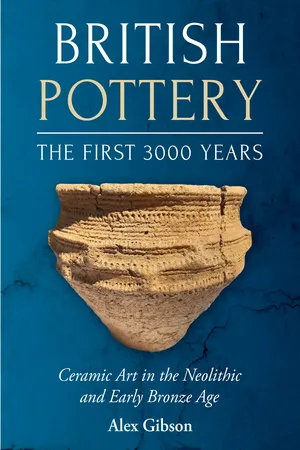
eBook - ePub
British Pottery: The First 3000 Years
Ceramic Art in the Neolithic and Early Bronze Age
- 208 pages
- English
- ePUB (mobile friendly)
- Available on iOS & Android
eBook - ePub
About this book
Information
Subtopic
British HistoryIndex
Social SciencesTable of contents
- Cover page
- Title page
- Copyright
- Contents
- List of figures and tables
- Acknowledgements
- Introduction
- 1. All fired up: Ceramic technology
- 2. The first 500 years (c. 4000–3500 BC): The arrival of pottery
- 3. First impressions (3500–3000 BC): The Middle Neolithic
- 4. In the groove (3000–2500 BC): The Later Neolithic
- 5. European (re)union (2500–1800 BC): Beakers of the Chalcolithic to Early Bronze Age
- 6. Neolithic renaissance? (c. 2000–1500 BC): The Early Bronze Age
- 7. Regionality and decline (2000–1000 BC): The Early and Middle Bronze Age
- 8. Postscript
- Bibliography
Trusted by 375,005 students
Access to over 1.5 million titles for a fair monthly price.
Study more efficiently using our study tools.
Frequently asked questions
Yes, you can cancel anytime from the Subscription tab in your account settings on the Perlego website. Your subscription will stay active until the end of your current billing period. Learn how to cancel your subscription
No, books cannot be downloaded as external files, such as PDFs, for use outside of Perlego. However, you can download books within the Perlego app for offline reading on mobile or tablet. Learn how to download books offline
Perlego offers two plans: Essential and Complete
- Essential is ideal for learners and professionals who enjoy exploring a wide range of subjects. Access the Essential Library with 800,000+ trusted titles and best-sellers across business, personal growth, and the humanities. Includes unlimited reading time and Standard Read Aloud voice.
- Complete: Perfect for advanced learners and researchers needing full, unrestricted access. Unlock 1.5M+ books across hundreds of subjects, including academic and specialized titles. The Complete Plan also includes advanced features like Premium Read Aloud and Research Assistant.
We are an online textbook subscription service, where you can get access to an entire online library for less than the price of a single book per month. With over 1.5 million books across 990+ topics, we’ve got you covered! Learn about our mission
Look out for the read-aloud symbol on your next book to see if you can listen to it. The read-aloud tool reads text aloud for you, highlighting the text as it is being read. You can pause it, speed it up and slow it down. Learn more about Read Aloud
Yes! You can use the Perlego app on both iOS and Android devices to read anytime, anywhere — even offline. Perfect for commutes or when you’re on the go.
Please note we cannot support devices running on iOS 13 and Android 7 or earlier. Learn more about using the app
Please note we cannot support devices running on iOS 13 and Android 7 or earlier. Learn more about using the app
Yes, you can access British Pottery: The First 3000 Years by Alex Gibson in PDF and/or ePUB format, as well as other popular books in Social Sciences & British History. We have over 1.5 million books available in our catalogue for you to explore.