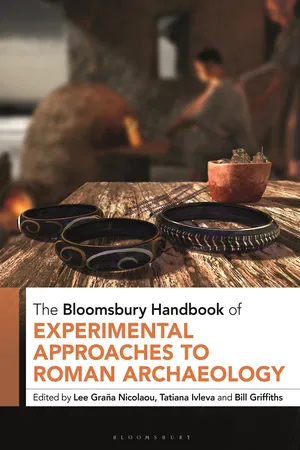
This volume is the first comprehensive overview of Roman experimental archaeology, exploring its key themes, methodologies and applications through a diverse array of international case studies. Experiments, simulations and reconstructions are important methods for understanding the past, from uncovering how ancient objects and structures were made, used, destroyed, deposited and affected underground, to illuminating the experiences of tasting ancient foods, fighting alongside comrades or living in replicated structures. Although the incorporation of experimentation has had great success in prehistoric studies, greater reliance on the wealth of literary and material sources remaining from the classical period has meant that its potential for Roman studies has yet to be fully realised.
The 26 chapters in this book are divided into 5 thematic parts, each of which opens with a contextualizing introduction that frames the detailed case studies found in individual chapters and showcases the actual and potential diversity of experimentation as applied to the Roman past by scholars, re-enactors, and practitioners in the heritage sector. In laying out a detailed guide to Roman experimental archaeology, the volume as a whole maps its past, present and future, and provides a firm foundation for further practical research and collaboration. In doing so, it reasserts that experiments and reconstructions are a significant resource for testing or developing theories, rather than merely artistic replicas, and that the vast amount of quantifiable data they yield can be invaluable in support of interpretations of relevant archaeological or historical evidence, regardless of the period in question and beyond the confines of academia.
eBook - ePub
The Bloomsbury Handbook of Experimental Approaches to Roman Archaeology
- 500 pages
- English
- ePUB (mobile friendly)
- Available on iOS & Android
eBook - ePub
The Bloomsbury Handbook of Experimental Approaches to Roman Archaeology
About this book
Information
Table of contents
- Cover
- Half-Title Page
- Series Page
- Title Page
- Copyright
- Contents
- List of Contributors
- List of Illustrations
- Foreword
- Preface
- Acknowledgements
- Introduction The Past, Present and Future Role of Experimental Research in Roman Studies
- Part I Experimentation as a Tool for Academic and Public Education
- 1 Towards Sets of Guidelines for Roman Re-enactment and Reconstruction Archaeology – Revisited
- 2 Doing (Roman) History: Blurring the Lines between Academics, Re-enactors and Artisans
- 2 Doing (Roman) History: Blurring the Lines between Academics, Re-enactors and Artisans
- 4 The Influence of Experimental Workshops on Archaeological Communities: The Impact of ‘TRACamp’
- Part II Rebuilding the Past: Architectural Reconstructions and Archaeological Open-air Museums
- 5 Adventures with a Hypocaust and Mass Cob Walling
- 6 Mind the Gap(s): Theoretical and Hands-on Approaches to the Production of Roman Brick and Tile
- 7 Rammed Earth, Hand-hewn Timber and Wood-fired Tiles: The Physical Reconstruction of Three Roman Craftsmen Houses at Xanten, Germany
- 8 The Oil Merchant’s House in the Roman City Quarter of Carnuntum
- Part III Actualistic Experiments: Activities, Processes and Chains of Production
- 9 Ancient Fish Sauce at the Roman Table: Identifying Archaeological Traces of Ancient Recipes via Experimental Research into the Use and Deposition of Cooking Wares
- 10 The Panis Quadratus: Form, Flour and Tools of the Trade
- 11 Roman Leather Manufacture and the Archaeological Record: An Experimental Approach
- 12 Off with Their Heads! Broken Figurines and Religious Practice in Roman Britain
- 13 An Experimental Approach to the Study of the Roman Oil Lamp
- 14 The Role of Interdisciplinary Experiments in Developing Untested Theories: The Application of Engineering and Digital Approaches in the Study of Roman Dyeing Vats from Pompeii
- 15 Testing Ethnographic Hypotheses with Reconstructed Artefacts: Replicated Lead Fishing Net Weights and Their Use on Cast Nets
- Part IV Experiencing the Past: Sensory Experiences and Interpretations
- 16 Approaching the Romano-British Glass Bangle Craft with a Craftsperson Perspective
- 17 Reconstructing Recipes from ‘Apicius’: Professional Observations on Practices, Consistencies and Successes
- 18 The Price of a Mile: Marching and Its Impact on the Soldier: An Approximation to the Roman Republican Army through an Experimental Perspective
- 19 Identifying Severe Hair Loss via the Reproduction of Known Roman Hair Styles: The Case of Julia Domna
- 20 Interpreting Clothing of the Late Antique Period: The Role of Experimental Archaeology
- Part V Digital Technologies: 3D Reconstructions and Gaming
- 21 3D Reconstructions as an Educational Tool
- 22 Methods and Applications of 3D Digital Reconstructions: The Roman Fishponds of Maritime Villas in Southern Latium
- 23 Shedding Light in Roman Houses: Using 3D Reconstructions to Analyse the Use of Natural Light
- 24 Digital Reconstructions as a Method to Test the Feasibility of Multiple Interpretations of Archaeological Artefacts as Illustrated by a Case Study of a Belt-like Object from Second-century ce Vimose
- 25 Rome Was Not Built in a Day: Reimagining the Roman Empire in Video Games
- 26 The Missing Dead: Reconstructing the Past through Digital Gameplay at Roman Vindolanda
- Conclusion
- Index
Trusted by 375,005 students
Access to over 1.5 million titles for a fair monthly price.
Study more efficiently using our study tools.
Frequently asked questions
Yes, you can cancel anytime from the Subscription tab in your account settings on the Perlego website. Your subscription will stay active until the end of your current billing period. Learn how to cancel your subscription
No, books cannot be downloaded as external files, such as PDFs, for use outside of Perlego. However, you can download books within the Perlego app for offline reading on mobile or tablet. Learn how to download books offline
Perlego offers two plans: Essential and Complete
- Essential is ideal for learners and professionals who enjoy exploring a wide range of subjects. Access the Essential Library with 800,000+ trusted titles and best-sellers across business, personal growth, and the humanities. Includes unlimited reading time and Standard Read Aloud voice.
- Complete: Perfect for advanced learners and researchers needing full, unrestricted access. Unlock 1.5M+ books across hundreds of subjects, including academic and specialized titles. The Complete Plan also includes advanced features like Premium Read Aloud and Research Assistant.
We are an online textbook subscription service, where you can get access to an entire online library for less than the price of a single book per month. With over 1.5 million books across 990+ topics, we’ve got you covered! Learn about our mission
Look out for the read-aloud symbol on your next book to see if you can listen to it. The read-aloud tool reads text aloud for you, highlighting the text as it is being read. You can pause it, speed it up and slow it down. Learn more about Read Aloud
Yes! You can use the Perlego app on both iOS and Android devices to read anytime, anywhere — even offline. Perfect for commutes or when you’re on the go.
Please note we cannot support devices running on iOS 13 and Android 7 or earlier. Learn more about using the app
Please note we cannot support devices running on iOS 13 and Android 7 or earlier. Learn more about using the app
Yes, you can access The Bloomsbury Handbook of Experimental Approaches to Roman Archaeology by Lee Graña Nicolaou,Tatiana Ivleva,Bill Griffiths in PDF and/or ePUB format, as well as other popular books in Social Sciences & Roman Ancient History. We have over 1.5 million books available in our catalogue for you to explore.