- 272 pages
- English
- ePUB (mobile friendly)
- Available on iOS & Android
Black 1968
About this book
Initially, the 1960s was a time of understandable optimism. The civil rights movement and the legislation it inspired suggested an end to institutionalized racism in the United States, while in the Global South, the emergence of independent states anticipated political liberation and increased prosperity. So, when racial discrimination, entrenched privilege, cold war politics, and fiscal reality dashed these hopes later in the decade, the world experienced a wave of protests. Conventional narratives of 1968 focus on student strikes, revolutions and coups, assassinations, and the reactionary backlash that they inspired.
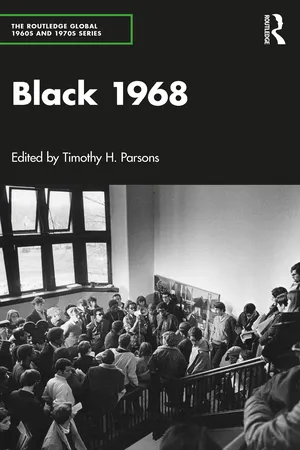
The chapters of Black 1968 reveal the imperfectly documented and heretofore unrecognized bonds that led peoples of African descent around the world to articulate new global conceptions of Blackness as a way to mount local challenges to racism, segregation, colonialism, economic exploitation, generational authority, and cultural chauvinism.
This book will be of interest to general readers interested in the global 1968 as well as scholars of Blackness and global history.
Tools to learn more effectively

Saving Books

Keyword Search

Annotating Text

Listen to it instead
Information
Table of contents
- Cover
- Half-Title
- Series
- Title
- Copyright
- Dedication
- Contents
- List of contributors
- Preface/Acknowledgments
- 1 Introduction
- 2 “We Are Not White. We Don’t Want to Be White.”: Washington University’s Black Radical Awakening
- 3 The Great Memory: How St. Clair County Remembers Martin Luther King Jr.
- 4 Melvin Van Peebles, James Brown, Frank Yerby, and Some Observations about the Black 1968
- 5 Black 1968 and Palestine: Transnationalism, Anti-Imperialism, and Revolutionary Culture
- 6 “We Shall Overcome” and Ireland: The Transatlantic Politics of a Protest Song
- 7 Black Power in Britain: An Indictment Against the 1968 Race Relations Act
- 8 How the Banning of Walter Rodney Led to the Birth of Bogle-L’Ouverture Publications
- 9 The Ideological Melting Pot of the Senegalese Rebels in 1968: Between Marxism, Fanonism, and Pan-Africanism
- 10 May 1968 and the Question of Africanization of the Educational System in Senegal
- 11 Black Enclaves after Reconstruction: Cultivating Collective Identity in Preparation for the Revolution of 1968
- Index
Frequently asked questions
- Essential is ideal for learners and professionals who enjoy exploring a wide range of subjects. Access the Essential Library with 800,000+ trusted titles and best-sellers across business, personal growth, and the humanities. Includes unlimited reading time and Standard Read Aloud voice.
- Complete: Perfect for advanced learners and researchers needing full, unrestricted access. Unlock 1.4M+ books across hundreds of subjects, including academic and specialized titles. The Complete Plan also includes advanced features like Premium Read Aloud and Research Assistant.
Please note we cannot support devices running on iOS 13 and Android 7 or earlier. Learn more about using the app