Every ten years, states go through the process of redistricting: choosing how to divide up and apportion their state and federal legislative districts. How the districts are drawn can determine which party wins the district and therefore controls the legislature or Congress. Although the process may be different in every state, the questions are the same: Who draws the maps? Who can prevent gerrymandering? What power do legislatures, governors, courts, and political parties have to influence the process and the outcomes?
In Constructing a Democracy, legal scholar Norman Williams presents a comprehensive history of legislative and congressional redistricting in Oregon. Because redistricting impacts the representativeness of the ensuing legislative body, Oregon's constitutional framers, legislators, and courts alike have understandably focused on developing legal rules to constrain the redistricting process. Williams is primarily interested in identifying and understanding the scope of those rules: What legal constraints have existed over time? How aggressively have the courts enforced those restraints? How have political actors undertaken the redistricting task in light of the various rules and the judicial pronouncements regarding those constraints?
The redistricting process in Oregon has not drawn national attention the way it has in states like North Carolina and Pennsylvania. But the process in Oregon is notable in several ways, including an early attention to malapportionment, the use of the initiative to reform the process, and and the impact of women leaders on the redistricting process. The Oregon process, however, has also notably lagged behind other states, particularly in considering issues of race and minority representation and preventing gerrymandering.
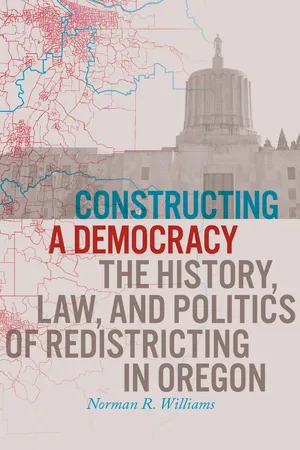
eBook - ePub
Constructing a Democracy
The History, Law, and Politics of Redistricting in Oregon
- 376 pages
- English
- ePUB (mobile friendly)
- Available on iOS & Android
eBook - ePub
Constructing a Democracy
The History, Law, and Politics of Redistricting in Oregon
About this book
Information
Table of contents
- Cover Page
- Title Page
- Copyright Page
- Contents
- Preface
- Introduction
- 1. The State Constitution and Legislative Redistricting: 1859–1890
- 2. Republican Ascendancy and the Wasco Gambit: 1890–1903
- 3. Malapportionment, Sectionalism, and Unicameralism: 1907–1941
- 4. Constitutional Reform: 1945–1961
- 5. Single-Member Districts, Partisanship, and Judicial Retreat: 1971–1981
- 6. Constitutional Reform, Part Two, and Judicial Deference Redux: 1985–2011
- 7. Congressional Redistricting: 1891–2011
- 8. The 2021 Restricting Cycle
- Conclusion
- Appendix A: County Apportionment—Oregon Senate and House of Representatives, 1859–1971
- Appendix B: Or. Const. art. IV, § 6(4)
- Notes
- Index
Trusted by 375,005 students
Access to over 1.5 million titles for a fair monthly price.
Study more efficiently using our study tools.
Frequently asked questions
Yes, you can cancel anytime from the Subscription tab in your account settings on the Perlego website. Your subscription will stay active until the end of your current billing period. Learn how to cancel your subscription
No, books cannot be downloaded as external files, such as PDFs, for use outside of Perlego. However, you can download books within the Perlego app for offline reading on mobile or tablet. Learn how to download books offline
Perlego offers two plans: Essential and Complete
- Essential is ideal for learners and professionals who enjoy exploring a wide range of subjects. Access the Essential Library with 800,000+ trusted titles and best-sellers across business, personal growth, and the humanities. Includes unlimited reading time and Standard Read Aloud voice.
- Complete: Perfect for advanced learners and researchers needing full, unrestricted access. Unlock 1.5M+ books across hundreds of subjects, including academic and specialized titles. The Complete Plan also includes advanced features like Premium Read Aloud and Research Assistant.
We are an online textbook subscription service, where you can get access to an entire online library for less than the price of a single book per month. With over 1.5 million books across 990+ topics, we’ve got you covered! Learn about our mission
Look out for the read-aloud symbol on your next book to see if you can listen to it. The read-aloud tool reads text aloud for you, highlighting the text as it is being read. You can pause it, speed it up and slow it down. Learn more about Read Aloud
Yes! You can use the Perlego app on both iOS and Android devices to read anytime, anywhere — even offline. Perfect for commutes or when you’re on the go.
Please note we cannot support devices running on iOS 13 and Android 7 or earlier. Learn more about using the app
Please note we cannot support devices running on iOS 13 and Android 7 or earlier. Learn more about using the app
Yes, you can access Constructing a Democracy by Norman R. Williams in PDF and/or ePUB format, as well as other popular books in Politics & International Relations & American Government. We have over 1.5 million books available in our catalogue for you to explore.