Winner of the 2026 International Communication Association Outstanding Book Award
Winner of the 2026 Philosophy, Theory and Critique (PTC-ICA) Book Award
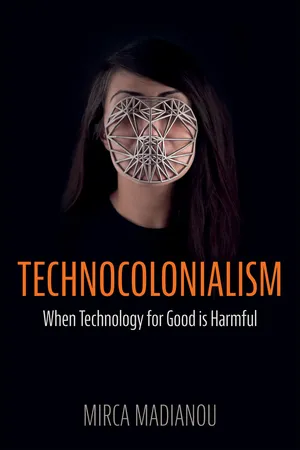
With over 300 million people in need of humanitarian assistance, and with emergencies and climate disasters becoming more common, AI and big data are being championed as forces for good and as solutions to the complex challenges of the aid sector.
This book argues, however, that digital innovation engenders new forms of violence and entrenches power asymmetries between the global South and North. Madianou develops a new concept, technocolonialism, to capture how the convergence of digital developments with humanitarian structures, state power and market forces reinvigorates and reshapes colonial legacies. The concept of technocolonialism shifts the attention to the constitutive role that digital infrastructures, data and AI play in accentuating inequities between aid providers and people in need.
Drawing on ten years of research on the uses of digital technologies in humanitarian operations, the book examines a range of practices: from the normalization of biometric technologies and the datafication of humanitarian operations to experimentation in refugee camps, which are treated as laboratories for technological pilots. In so doing, the book opens new ground in the fields of humanitarianism and critical AI studies, and in the debates in postcolonial studies, by highlighting the fundamental role of digital technologies in reworking colonial genealogies.
- 258 pages
- English
- PDF
- Available on iOS & Android
eBook - PDF
About this book
Information
Table of contents
- Cover
- Title page
- Copyright
- Contents
- Abbreviations
- Introduction
- 1 The Logics of Digital Humanitarianism
- 2 Biometric Infrastructures
- 3 Extracting Data and the Illusion of Accountability
- 4 Surreptitious Experimentation
- 5 The Humanitarian Machine
- 6 Mundane Resistance
- Conclusion
- A Note on Research Methods
- Acknowledgements
- Notes
- References
- Index
- EULA
Trusted by 375,005 students
Access to over 1.5 million titles for a fair monthly price.
Study more efficiently using our study tools.
Frequently asked questions
Yes, you can cancel anytime from the Subscription tab in your account settings on the Perlego website. Your subscription will stay active until the end of your current billing period. Learn how to cancel your subscription
No, books cannot be downloaded as external files, such as PDFs, for use outside of Perlego. However, you can download books within the Perlego app for offline reading on mobile or tablet. Learn how to download books offline
Perlego offers two plans: Essential and Complete
- Essential is ideal for learners and professionals who enjoy exploring a wide range of subjects. Access the Essential Library with 800,000+ trusted titles and best-sellers across business, personal growth, and the humanities. Includes unlimited reading time and Standard Read Aloud voice.
- Complete: Perfect for advanced learners and researchers needing full, unrestricted access. Unlock 1.5M+ books across hundreds of subjects, including academic and specialized titles. The Complete Plan also includes advanced features like Premium Read Aloud and Research Assistant.
We are an online textbook subscription service, where you can get access to an entire online library for less than the price of a single book per month. With over 1.5 million books across 990+ topics, we’ve got you covered! Learn about our mission
Look out for the read-aloud symbol on your next book to see if you can listen to it. The read-aloud tool reads text aloud for you, highlighting the text as it is being read. You can pause it, speed it up and slow it down. Learn more about Read Aloud
Yes! You can use the Perlego app on both iOS and Android devices to read anytime, anywhere — even offline. Perfect for commutes or when you’re on the go.
Please note we cannot support devices running on iOS 13 and Android 7 or earlier. Learn more about using the app
Please note we cannot support devices running on iOS 13 and Android 7 or earlier. Learn more about using the app
Yes, you can access Technocolonialism by Mirca Madianou in PDF and/or ePUB format, as well as other popular books in Social Sciences & Media Studies. We have over 1.5 million books available in our catalogue for you to explore.