Archaeoacoustics studies historical sound, merging archaeology, anthropology, and psychology to reveal insights about ancient music and acoustic environments.
Exploring Ancient Sounds and Places: Theoretical and Methodological Approaches to Archaeoacoustics brings together scholars from diverse academic fields – including archaeology, anthropology, architecture, classics, history, art history and sound engineering – to shed light on the role of sound and acoustics in the cultural practices of past societies from various chronologies and locations around the world. This innovative volume covers a broad spectrum of topics, such as the genesis of archaeological investigations into sound, the emergence of speech and song in early humans, the cognitive effects of music in ritualistic contexts, the acoustic dimensions of rock art sites, and the emotional responses elicited by sonorous activities experienced in these decorated spaces. Additionally, the book delves into the study of prehistoric musical instruments, the use of ethnohistorical sources in archaeoacoustic research, the analysis of sound imagery in medieval frescoes, and explores historical approaches to the study of specific acoustic parameters and the sonic properties of urban environments. Each chapter not only aggregates a wealth of academic perspectives but also bridges the gap between theoretical concepts and the most advanced methods used in this field of research. Case studies from all over the world illustrate the different ways in which ancient communities perceived and engaged with sound and the acoustics of the landscapes in which they were immersed. Exploring Ancient Sounds and Places is an essential resource for scholars and students interested in archaeoacoustics and how sound has shaped the cognitive, cultural and spiritual facets of human societies across time and space.
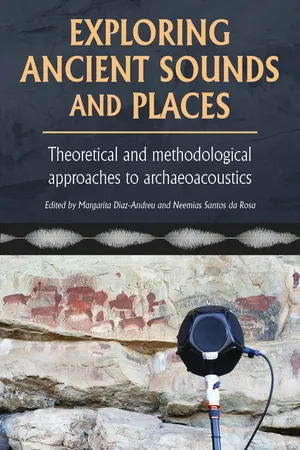
eBook - ePub
Exploring Ancient Sounds and Places
Theoretical and Methodological Approaches to Archaeoacoustics
- 256 pages
- English
- ePUB (mobile friendly)
- Available on iOS & Android
eBook - ePub
Exploring Ancient Sounds and Places
Theoretical and Methodological Approaches to Archaeoacoustics
About this book
Information
Subtopic
History of ArtIndex
Social SciencesTable of contents
- Cover page
- Title page
- Copyright
- Contents
- List of contributors
- 1. Exploring ancient sounds and places: The challenges of hearing intangible heritage in the past
- 2. The role of listening in the prehistorical emergence of speech and song: A precursor to becoming human?
- 3. Archoustemology and the Aurignacian: Ancient ways of knowing through sound
- 4. The sounds are audible: Fabricating ancient instruments – what more can we learn?
- 5. Methodologies to explore the cognitive effects of music in rituals: Implications for studying ancient ritual activities
- 6. Methods for psychoacoustic and emotional evaluation of archaeological soundscapes with auralisation
- 7. Ethnohistorical sources in archaeoacoustics research: A case study from South-Central California
- 8. Early rock music: Methodology to identify and analyse portable lithophones. An example from Great Sand Dunes National Park and Preserve in the San Luis Valley, Colorado, US
- 9. Preliminary insights into the archaeoacoustics of cup-marked sounding rocks in the north area of the Gredos mountain chain, Spain
- 10. The rock art soundscapes of the Karakol valley (Republic of Altai, Russia): An archaeoacoustic study of a unique landscape
- 11. Sound imagery in medieval Serbian frescoes
- 12. Acoustic space then and now: Listening to history
- 13. Estimation of speech intelligibility in the past: Learning from Benjamin Franklin’s experiment
Trusted by 375,005 students
Access to over 1.5 million titles for a fair monthly price.
Study more efficiently using our study tools.
Frequently asked questions
Yes, you can cancel anytime from the Subscription tab in your account settings on the Perlego website. Your subscription will stay active until the end of your current billing period. Learn how to cancel your subscription
No, books cannot be downloaded as external files, such as PDFs, for use outside of Perlego. However, you can download books within the Perlego app for offline reading on mobile or tablet. Learn how to download books offline
Perlego offers two plans: Essential and Complete
- Essential is ideal for learners and professionals who enjoy exploring a wide range of subjects. Access the Essential Library with 800,000+ trusted titles and best-sellers across business, personal growth, and the humanities. Includes unlimited reading time and Standard Read Aloud voice.
- Complete: Perfect for advanced learners and researchers needing full, unrestricted access. Unlock 1.5M+ books across hundreds of subjects, including academic and specialized titles. The Complete Plan also includes advanced features like Premium Read Aloud and Research Assistant.
We are an online textbook subscription service, where you can get access to an entire online library for less than the price of a single book per month. With over 1.5 million books across 990+ topics, we’ve got you covered! Learn about our mission
Look out for the read-aloud symbol on your next book to see if you can listen to it. The read-aloud tool reads text aloud for you, highlighting the text as it is being read. You can pause it, speed it up and slow it down. Learn more about Read Aloud
Yes! You can use the Perlego app on both iOS and Android devices to read anytime, anywhere — even offline. Perfect for commutes or when you’re on the go.
Please note we cannot support devices running on iOS 13 and Android 7 or earlier. Learn more about using the app
Please note we cannot support devices running on iOS 13 and Android 7 or earlier. Learn more about using the app
Yes, you can access Exploring Ancient Sounds and Places by Margarita Díaz-Andreu,Neemias Santos da Rosa in PDF and/or ePUB format, as well as other popular books in Social Sciences & History of Art. We have over 1.5 million books available in our catalogue for you to explore.