There is the country non-Indigenous people can see, and then there is the country Indigenous people see that the rest of us can barely comprehend, but glimpse through the vivid colours, shapes and imagery of their artworks, and their visual recounting of ancient stories and settings.
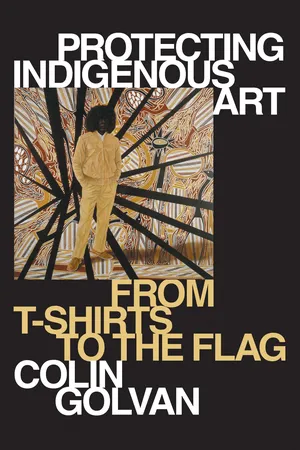
The unauthorised use of Indigenous artworks is a global industry that damages cultural integrity and harms the livelihoods of artists and their communities. While the western idea of private or individual ownership can be at significant odds with tenets of Indigenous ownership and control, copyright remains one of the primary tools available to protect Indigenous visual artists from fakes, cultural threat and appropriation. In Protecting Indigenous Art, leading intellectual property barrister Colin Golvan provides a privileged insight into how legal protection of Indigenous art offers unique opportunities to empower Indigenous artists and their communities. Golvan gives a first-hand account of landmark legal campaigns such as the unauthorised reproduction of prominent Bulun Bulun artworks on T-shirts, the seminal carpets case, the campaign to recover the copyright of Arrernte artist Albert Namatjira and the extraordinary story of the Aboriginal flag.Altogether, we get an understanding of the importance of protection for this much-loved form of artistic and cultural expression.
- English
- ePUB (mobile friendly)
- Available on iOS & Android
eBook - ePub
About this book
Information
Edition
0Table of contents
- Cover
- Title Page
- Copyright Page
- Contents
- 1 Protecting Indigenous art
- 2 Becoming involved
- 3 The T-shirts case
- 4 Yumbulul and the ten dollar note case
- 5 The carpets case
- 6 Copyright and communal ownership
- 7 Fakery
- 8 Cultural heritage protection
- 9 Namatjira
- 10 The Aboriginal Flag
- Epilogue
- Acknowledgements
- Index
Trusted by 375,005 students
Access to over 1.5 million titles for a fair monthly price.
Study more efficiently using our study tools.