Path-breaking innovations are about instigating fundamental changes in people, organizations, communities, and economies. They are complex, continuous, and evolutionary processes that take considerable time, resources, and the efforts of many individuals and organizations to be accomplished successfully. Representing distinct departures from existing practices, they differ from other types of innovation, such as product extensions and incremental improvements. By examining path-breaking innovation processes through in-depth analysis of several large-scale initiatives around the world, the authors explore how profound changes in product, process, and service can be explained and managed, and consider the practical implications for scientific, organizational, institutional, and political leaders concerned with channeling innovation toward economic growth.
In-depth analysis of science and technology initiatives at CERN-ATLAS, Airbus, and in stem cell research, the authors explore and illuminate how profound changes in product, process, and service can be explained and managed. Covering such issues as organizational culture, types of knowledge, and large-scale project management and resource distribution, the authors consider the practical implications of radical innovation for scientific, organizational, institutional, and political leaders concerned with channeling innovation toward economic growth.
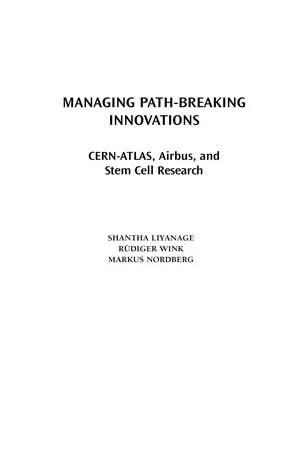
eBook - PDF
Managing Path-Breaking Innovations
CERN-ATLAS, Airbus, and Stem Cell Research
- 349 pages
- English
- PDF
- Available on iOS & Android
eBook - PDF
Managing Path-Breaking Innovations
CERN-ATLAS, Airbus, and Stem Cell Research
Table of contents
- CONTENTS
- Tables and Figures
- Foreword by Peter Jenni
- Preface
- Acknowledgments
- 1 Science and Radical Change
- 2 Philosophy of Production and Work
- 3 Strategies and Collaboration of Big Science and Technology Projects
- 4 The Changed Environment for Radical Innovations
- 5 Innovation and Production in the Twenty-first Century: The Spatial Dimension
- 6 Leadership and Creativity in Path-breaking Innovations
- 7 Funding and Commodification: Managing Resources for Path-breaking Innovations
- 8 Future Scenarios for Knowledge Construction
- Notes
- Selected Bibliography
- Index
- Table 3-1 A Comparison of CERN, Stem Cell Research, and Airbus Innovation Efforts
- Table 3-2 Big Science Groups Engaged in Accelerator Research
- Table 3-3 Example of an ATLAS Action List
- Table 4-1 Status of Airbus Orders as of 2006
- Table 4-2 Public and Private Funding for Stem Cell Research in Several Countries
- Table 5-1 Copublications in Stem Cell Research, 2001–2003
- Table 6-1 Leadership in Atomic, Nuclear, and Particle Physics over a Century
- Table 6-2 Scientific Norms and Cultural Context
- Table 6-3 Collaborative Publications by Senior Leaders
- Table 6-4 Research Fields of Publications in Stem Cell Research
- Table 6-5 International Journal Publications in Stem Cell Research, 2001–2003
- Table 6-6 Copublications between Researchers from Different Organizations
- Figure 1-1 The Path-breaking Innovation Process
- Figure 2-1 Types of Human Labor for Work and Production
- Figure 2-2 Waves of Technological Innovations
- Figure 3-1 The Four-Particle Detector Experiments at CERN
- Figure 3-2 The ATLAS Organizational Structure
- Figure 3-3 Role of Technology Management Board in the ATLAS Hierarchy
- Figure 3-4 ATLAS Team at Work
- Figure 3-5 Flow of Resources in ATLAS Collaboration
- Figure 3-6 ATLAS Top Action List
- Figure 3-7 Collaboration Coordinates
- Figure 4-1 Production Value Chain and the Customers
- Figure 4-2 Net Aircraft Orders of Airbus and Boeing
- Figure 4-3 A Comparison of Airbus Family and Competitor Products
- Figure 4-4 Airbus Manufacturing Facilities in Europe
- Figure 4-5 Logistic Coordination of Airbus Production
- Figure 5-1 Global Market Shares in R&D Intensive Goods (in percent)
- Figure 5-2 Annual Growth Rates of Services Imports of United States, 1992–2002
- Figure 5-3 Share of Growth of R&D Expenditure in Selected Countries, 1993–2003
- Figure 5-4 R&D Expenditures by Selected Transnational Companies and Countries, 2002 (in US$ billion)
- Figure 5-5 Most Attractive Prospective R&D Locations (in percent of answers by the 700 Biggest Private R&D Spenders)
- Figure 5-6 Network of Stem Cell Copublications
- Figure 5-7 Structure of Global Economic Performance
- Figure 5-8 Growth Rates in Fast Growth Periods
- Figure 5-9 Gross Expenditures on R&D as Percentage of Gross Domestic Products
- Figure 5-10 Triad Patents Per Million Inhabitants
- Figure 5-11 Traditional Product Life Cycle
- Figure 6-1 Radical Interactions among Scientific Leaders
- Figure 7-1 Airbus Turnover (in US$ billion)
- Figure 7-2 Airbus Order Backlog
Trusted by 375,005 students
Access to over 1.5 million titles for a fair monthly price.
Study more efficiently using our study tools.
Frequently asked questions
Yes, you can cancel anytime from the Subscription tab in your account settings on the Perlego website. Your subscription will stay active until the end of your current billing period. Learn how to cancel your subscription
No, books cannot be downloaded as external files, such as PDFs, for use outside of Perlego. However, you can download books within the Perlego app for offline reading on mobile or tablet. Learn how to download books offline
Perlego offers two plans: Essential and Complete
- Essential is ideal for learners and professionals who enjoy exploring a wide range of subjects. Access the Essential Library with 800,000+ trusted titles and best-sellers across business, personal growth, and the humanities. Includes unlimited reading time and Standard Read Aloud voice.
- Complete: Perfect for advanced learners and researchers needing full, unrestricted access. Unlock 1.5M+ books across hundreds of subjects, including academic and specialized titles. The Complete Plan also includes advanced features like Premium Read Aloud and Research Assistant.
We are an online textbook subscription service, where you can get access to an entire online library for less than the price of a single book per month. With over 1.5 million books across 990+ topics, we’ve got you covered! Learn about our mission
Look out for the read-aloud symbol on your next book to see if you can listen to it. The read-aloud tool reads text aloud for you, highlighting the text as it is being read. You can pause it, speed it up and slow it down. Learn more about Read Aloud
Yes! You can use the Perlego app on both iOS and Android devices to read anytime, anywhere — even offline. Perfect for commutes or when you’re on the go.
Please note we cannot support devices running on iOS 13 and Android 7 or earlier. Learn more about using the app
Please note we cannot support devices running on iOS 13 and Android 7 or earlier. Learn more about using the app
Yes, you can access Managing Path-Breaking Innovations by Shantha Liyanage,Rudiger Wink,Markus Nordberg in PDF and/or ePUB format, as well as other popular books in Business & Business General. We have over 1.5 million books available in our catalogue for you to explore.