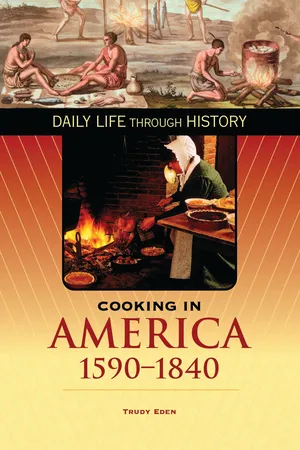
There are no recipes for what the Indians ate in Colonial times, but this cookbook uses period quotations to detail what and how the foodstuffs were prepared. The bulk of the cookbook is devoted to what the European immigrants cooked and what evolved into American cooking. The first colonists from England brought their foodways to America. The basic foods that Americans of European descent ate changed very little from 1600 to 1840. While the major basic foods remained the same, their part in the total diet changed. Americans at the end of the period ate far more beef and chicken than did the first colonists. They used more milk, butter and cream. They also ate more wheat in the form of breads, cakes, cookies, crackers and cereals. The same was true with fruits. Over time the more exotic vegetables like broccoli, cauliflower, artichokes, and numerous root vegetables including both sweet and white potatoes became common vegetables. By the end of this period, many Americans were even eating foods like tomatoes, okra, and sesame, which were unknown to their ancestors. In addition, Americans, like their relatives in Europe, incorporated coffee, tea, and chocolate into their diets as well as more sugar. Along with them came new customs, such as tea time, and, for men, socializing at coffeehouses. Also, distilled beverages, particularly rum, which was often made into a punch with citrus juices, were increasingly used.
Basic cooking technology also remained the same throughout the period, and the cookbook gives a sense of how meals were prepared. The open hearth provided the major heat source. As time passed, though, more and more people could afford to have wood-fired brick ovens in their homes. Although the recipes presented here from the first century of colonization come from cookbooks written for people of upper status, by the end of the time period, literacy rates were much higher among men and women. European and American authors published numerous cookbooks that were relatively inexpensive and available, so it is reasonable to assume that those recipes were representative of actual American cookery practices. Many changes occurred to cookbooks and recipes during this period. The recipes became more detailed and more reliant on standard measures, and the recipes were for foods that are less complicated and expensive to prepare. This fact is more a sign that cookbooks were being written for a less wealthy group of readers than that tastes and appetites had changed. The trend toward simple and frugal foods continued up to 1840 and beyond, a sign that readership had expanded as well as an indicator of what the bulk of Americans were eating. As well, recipes that were considered American were developed. All of these recipes are in their original form and have been taken from contemporary published or private cookbooks. The explanations after the recipes give historical information and suggestions if the recipe is vague or if it calls for an unusual ingredient. Dining tips are included as well. Period illustrations complement the recipes.
eBook - PDF
Cooking in America, 1590-1840
About this book
Information
Table of contents
- CONTENTS
- List of Recipes
- Glossary
- Series Foreword
- Acknowledgments
- Introduction
- 1. Native Americans
- 2. 1590–1675
- 3. 1675–1740
- 4. 1740–1800
- 5. 1800–1840
- Suggested Menus
- Notes
- Bibliography
- Index
Trusted by 375,005 students
Access to over 1.5 million titles for a fair monthly price.
Study more efficiently using our study tools.
Frequently asked questions
Yes, you can cancel anytime from the Subscription tab in your account settings on the Perlego website. Your subscription will stay active until the end of your current billing period. Learn how to cancel your subscription
No, books cannot be downloaded as external files, such as PDFs, for use outside of Perlego. However, you can download books within the Perlego app for offline reading on mobile or tablet. Learn how to download books offline
We are an online textbook subscription service, where you can get access to an entire online library for less than the price of a single book per month. With over 1.5 million books across 990+ topics, we’ve got you covered! Learn about our mission
Look out for the read-aloud symbol on your next book to see if you can listen to it. The read-aloud tool reads text aloud for you, highlighting the text as it is being read. You can pause it, speed it up and slow it down. Learn more about Read Aloud
Yes! You can use the Perlego app on both iOS and Android devices to read anytime, anywhere — even offline. Perfect for commutes or when you’re on the go.
Please note we cannot support devices running on iOS 13 and Android 7 or earlier. Learn more about using the app
Please note we cannot support devices running on iOS 13 and Android 7 or earlier. Learn more about using the app
Yes, you can access Cooking in America, 1590-1840 by Trudy Eden in PDF and/or ePUB format, as well as other popular books in Social Sciences & Popular Culture. We have over 1.5 million books available in our catalogue for you to explore.