Ufipa, a labor reserve for Tanganyika, witnessed minimal colonial development. Instead, evangelization by White Fathers' Catholic missionaries began in the 1870s. By the 1950s, the missionaries had secured varying degrees of political, economic and social authority in the region, witnessed by the fact that the vast majority of Fipa had converted to Catholicism. Fipa Families examines how this happened from the Fipa perspective.
Written primarily for scholars and students of African colonial history, mission history, and family and childhood history, this study is based on a rich collection of oral and documentary sources. Working with this wealth of information, Smythe breaks new ground in placing African social and moral concerns parallel to those of missionaries, resurrecting the study of the family (rather than kinship, lineage, or clan) within African history, and demonstrating at the level of the family and village the ways in which ideas of socialization, reproduction, and education were challenged and re-created in the colonial context in Ufipa.
Initially, employees of the mission sought to oversee the education and moral upbringing of at least one child from each family, substituting boarding school for the care relatives would otherwise have provided. A few mission parents even opted to forego the multiple benefits of grandchildren so a child could pursue the celibate path of a religious vocation.
The opportunities of the Catholic Church complemented and competed with Fipa processes of social and biological reproduction, and Catholicism became part of the fabric of Fipa society because of, and despite, its resonance with Fipa culture. At the heart of both Fipa and missionary concerns were the processes of socialization (social reproduction) and biological reproduction, processes carried out within the context of the family.
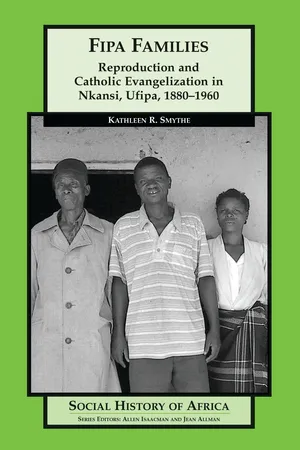
eBook - PDF
Fipa Families
Reproduction and Catholic Evangelization in Nkansi, Ufipa, 1880-1960
- 234 pages
- English
- PDF
- Available on iOS & Android
eBook - PDF
Fipa Families
Reproduction and Catholic Evangelization in Nkansi, Ufipa, 1880-1960
Table of contents
- CONTENTS
- Illustrations
- Acknowledgments
- Introduction: Fipa Families
- 1. Church, Religion, and State in Nkansi, 1880–1960
- 2. Where One Slept Mattered: Fipa Socialization and Cultural Perceptions of Growth in Nkansi, Ufipa, c. 1900
- 3. Home Away from Home: Generational Experiences and Attitudes Toward Boarding-School Education
- 4. The Boarding-School Experience: Baraza and Karema
- 5. Socializing Fipa Priests and Sisters
- 6. “Child of the Clan” or “Child of the Priests”: Life Stories of Two Fipa Catholic Sisters
- Conclusion: Fipa and Missionary Socialization
- Notes
- Bibliography
- Index
Trusted by 375,005 students
Access to over 1.5 million titles for a fair monthly price.
Study more efficiently using our study tools.
Frequently asked questions
Yes, you can cancel anytime from the Subscription tab in your account settings on the Perlego website. Your subscription will stay active until the end of your current billing period. Learn how to cancel your subscription
No, books cannot be downloaded as external files, such as PDFs, for use outside of Perlego. However, you can download books within the Perlego app for offline reading on mobile or tablet. Learn how to download books offline
Perlego offers two plans: Essential and Complete
- Essential is ideal for learners and professionals who enjoy exploring a wide range of subjects. Access the Essential Library with 800,000+ trusted titles and best-sellers across business, personal growth, and the humanities. Includes unlimited reading time and Standard Read Aloud voice.
- Complete: Perfect for advanced learners and researchers needing full, unrestricted access. Unlock 1.5M+ books across hundreds of subjects, including academic and specialized titles. The Complete Plan also includes advanced features like Premium Read Aloud and Research Assistant.
We are an online textbook subscription service, where you can get access to an entire online library for less than the price of a single book per month. With over 1.5 million books across 990+ topics, we’ve got you covered! Learn about our mission
Look out for the read-aloud symbol on your next book to see if you can listen to it. The read-aloud tool reads text aloud for you, highlighting the text as it is being read. You can pause it, speed it up and slow it down. Learn more about Read Aloud
Yes! You can use the Perlego app on both iOS and Android devices to read anytime, anywhere — even offline. Perfect for commutes or when you’re on the go.
Please note we cannot support devices running on iOS 13 and Android 7 or earlier. Learn more about using the app
Please note we cannot support devices running on iOS 13 and Android 7 or earlier. Learn more about using the app
Yes, you can access Fipa Families by Kathleen R. Smythe in PDF and/or ePUB format, as well as other popular books in History & African History. We have over 1.5 million books available in our catalogue for you to explore.