In most accounts of warfare, civilians suffer cruelties and make sacrifices silently and anonymously. This volume details the dismal impact war has had on the African people over the past five hundred years, from slavery days, the Zulu War, World Wars I and II, to the horrific civil wars following decolonization and the genocide in Rwanda.
In most accounts of warfare, civilians suffer cruelties and make sacrifices silently and anonymously. Finally, historians turn their attention to those who are usually caught up in events beyond their control or understanding. This volume details the dismal impact war has had on the African people over the past five hundred years, from slavery days, the Zulu War, World Wars I and II, to the horrific civil wars following decolonization and the genocide in Rwanda. Chapters provide a representative range of civilian experiences during wartime in Africa extending from the late eighteenth century to the present, representing every region of Africa except North Africa. Timelines, glossaries, suggested further readings and maps are included, and the work is fully indexed.
The book begins with Paul E. Lovejoy's study of the ubiquitous experience of African slavery which has so profoundly affected the development of the continent and the lives of its people. John Laband then examines the rise of the Zulu kingdom in the early nineteenth century and its subsequent conquest by Britain, thus charting the fate of civilians during the formation of an African kingdom and their experiences during colonial conquest. The Anglo-Boer War is situated at a crucial crossroads between colonial and modern warfare, and the concentration camps the British set up for Boer and African civilians pioneered a new form of modern savagery. Bill Nasson examines this war's complex effects on various categories of non-combatants in South Africa. Because it was under colonial rule, Africa was dragged into the two World Wars. Tim Stapleton shows in the fourth chapter that while the African civilian response to the war of 1914-1918 was often contradictory and ranged from collaboration to revolt, the effect of the conflict was only to confirm colonial rule. In the following chapter, David Killingray explains how and why the impact of the Second World War on African civilians was rather different from that of the First in that it undid colonial rule, and paved the way for the future independence of Africa under modernized African leadership. The Portuguese held on to their African empire long after the other colonial empires had relinquished theirs in the 1960s. Angola, the subject of Chapter six, passed seamlessly out of an independence struggle against Portuguese rule into civil war that soon involved Cold War rivalries and interventions. Inge Brinkman describes the dismal sufferings and displacement of Angolan civilians during four decades of interminable fighting. Liberia and Sierra Leone declined from relative stability and prosperity into horrific civil war, and in Chapter seven Lansana Gberie traces the deadly consequences for civilians and the efforts to stabilize society once peace was tentatively restored. The Sudan has suffered decades of ethnic and religious strife between the government and the people of the southern and western periphery, and in Chapter eight Jane Kani Edward and Amir Idris analyze what this has meant, and still means, for the myriad civilian victims. Chapter nine concludes the book with the most horrific single episode of recent African history: the Rwandan genocide. Alhaji Bah explains its genesis and canvasses the subsequent search for reconciliation. The chapter ends with his discussion of African mechanisms that should - and even might - be put in place to ensure effective peacekeeping in Africa, and so save civilians in future from the swarm of war's horrors.
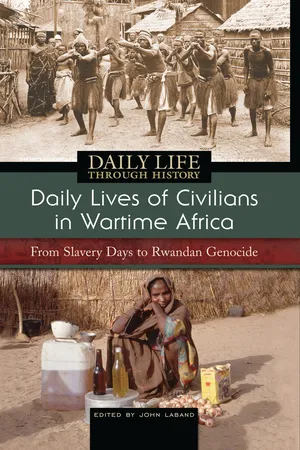
eBook - PDF
Daily Lives of Civilians in Wartime Africa
From Slavery Days to Rwandan Genocide
- 313 pages
- English
- PDF
- Available on iOS & Android
eBook - PDF
Daily Lives of Civilians in Wartime Africa
From Slavery Days to Rwandan Genocide
Table of contents
- Contents
- Series Foreword
- Introduction: African Civilians in Wartime
- 1. Civilian Casualties in the Context of the Trans-Atlantic Slave Trade
- 2. Zulu Civilians During the Rise and the Fall of the Zulu Kingdom, c. 1817–1879
- 3. Civilians in the Anglo-Boer War, 1899–1902
- 4. The Impact of the First World War on African People
- 5. African Civilians in the Era of the Second World War, c. 1935–1950
- 6. Angolan Civilians in Wartime, 1961–2002
- 7. Liberia and Sierra Leone: Civil Wars, 1989–2004
- 8. The Consequences of Sudan's Civil Wars for the Civilian Population
- 9. The Making of the Rwandan Genocide and the Future Protection of Civilians in Africa
- Index
- About the Editor and Contributors
Trusted by 375,005 students
Access to over 1.5 million titles for a fair monthly price.
Study more efficiently using our study tools.
Frequently asked questions
Yes, you can cancel anytime from the Subscription tab in your account settings on the Perlego website. Your subscription will stay active until the end of your current billing period. Learn how to cancel your subscription
No, books cannot be downloaded as external files, such as PDFs, for use outside of Perlego. However, you can download books within the Perlego app for offline reading on mobile or tablet. Learn how to download books offline
Perlego offers two plans: Essential and Complete
- Essential is ideal for learners and professionals who enjoy exploring a wide range of subjects. Access the Essential Library with 800,000+ trusted titles and best-sellers across business, personal growth, and the humanities. Includes unlimited reading time and Standard Read Aloud voice.
- Complete: Perfect for advanced learners and researchers needing full, unrestricted access. Unlock 1.5M+ books across hundreds of subjects, including academic and specialized titles. The Complete Plan also includes advanced features like Premium Read Aloud and Research Assistant.
We are an online textbook subscription service, where you can get access to an entire online library for less than the price of a single book per month. With over 1.5 million books across 990+ topics, we’ve got you covered! Learn about our mission
Look out for the read-aloud symbol on your next book to see if you can listen to it. The read-aloud tool reads text aloud for you, highlighting the text as it is being read. You can pause it, speed it up and slow it down. Learn more about Read Aloud
Yes! You can use the Perlego app on both iOS and Android devices to read anytime, anywhere — even offline. Perfect for commutes or when you’re on the go.
Please note we cannot support devices running on iOS 13 and Android 7 or earlier. Learn more about using the app
Please note we cannot support devices running on iOS 13 and Android 7 or earlier. Learn more about using the app
Yes, you can access Daily Lives of Civilians in Wartime Africa by John Paul Clow Laband Ph.D. in PDF and/or ePUB format, as well as other popular books in History & African History. We have over 1.5 million books available in our catalogue for you to explore.