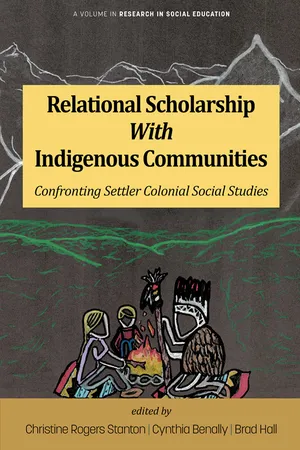
Relational Scholarship With Indigenous Communities
Confronting Settler Colonial Social Studies
- English
- PDF
- Available on iOS & Android
Relational Scholarship With Indigenous Communities
Confronting Settler Colonial Social Studies
About this book
All education and educational scholarship occurs on Indigenous Lands. Despite this reality, U.S. social studies education and scholarship has reinforced settler colonialism through curricula, teacher education, professional development, policy research, and more. To confront settler colonial social studies and transform the field, educators and scholars must engage relational approaches, prioritize community and student expertise, and commit to action that recognizes Indigenous Ways of Knowing.This book brings together Indigenous and non-Indigenous scholars, practitioners, and community partners from across the U.S. to share experiences of, stories about, and hopes for anti-colonial social studies. By sharing these examples, the book also provides methodological guidance for researchers, teacher educators, curriculum developers, and policymakers looking to learn about scholarly processes and partnerships with Indigenous communities. In addition to individual chapters, contributors engaged in conversations and collaboration between chapters and aboutthe book as a whole.Chapter co-authors and thought partners dialogued about the following questions: • What is relational research, and how can it help confront settler colonial content, processes, and praxis within social studies education?• How has social studies education and research (mis)represented and (mis)applied Indigenous Ways of Knowing?• How can a re-envisioning of social studies educational research be more intentionally participatory and relational to improve social studies teaching and learning, especially for and with Indigenous communities and youth?ENDORSEMENT: "Through relational scholarship, the co-editors and contributing scholars bring forward an essential call to action that centers Indigenous identities, histories, relations to land, and sovereignty. Embodied in Indigenous research and anti-colonial research methods, the collective work uniquely privileges Indigenous Peoples at the core of transforming the field of social studies for Indigenous futurities. Threaded throughout this book, are critical questions we should all be asking ourselves as we engage in advocacy, agency, and resurgence with and for Indigenous Peoples." — Jeremy Garcia (Hopi/Tewa), University of Arizona
Frequently asked questions
- Essential is ideal for learners and professionals who enjoy exploring a wide range of subjects. Access the Essential Library with 800,000+ trusted titles and best-sellers across business, personal growth, and the humanities. Includes unlimited reading time and Standard Read Aloud voice.
- Complete: Perfect for advanced learners and researchers needing full, unrestricted access. Unlock 1.4M+ books across hundreds of subjects, including academic and specialized titles. The Complete Plan also includes advanced features like Premium Read Aloud and Research Assistant.
Please note we cannot support devices running on iOS 13 and Android 7 or earlier. Learn more about using the app.
Information
Table of contents
- Cover
- Series page
- Relational Scholarship With Indigenous Communities
- Library of Congress Cataloging-in-Publication Data
- CONTENTS
- ACKNOWLEDGMENT OF COVER ART
- INTRODUCTION
- CHAPTER 1: A Love Letter to My Granddaughter
- CHAPTER 2: Engaging Relational Scholarship to Desettle
- CHAPTER 3: “More Than One Cup of Coffee”
- CHAPTER 4: “If This Isn’t Lifework, I Don’t Know What Is”
- CHAPTER 5: “You Listen and You Understand”
- CHAPTER 6: “Why Don’t We Get to Go Learn About That Stuff?”
- CHAPTER 7: Walking and Thinking Together
- CONCLUSION
- CONTRIBUTORS AND THOUGHT PARTNERS