eBook - ePub
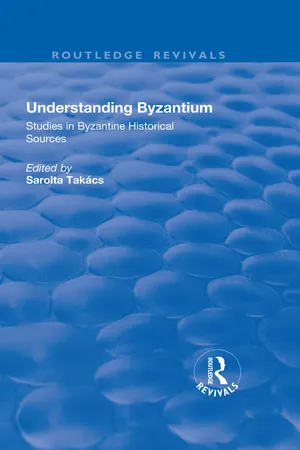
Understanding Byzantium
Studies in Byzantine Historical Sources
- 316 pages
- English
- ePUB (mobile friendly)
- Available on iOS & Android
eBook - ePub
About this book
This book was first published in 2003.Paul Speck's work is acknowledged to be of profound importance for the study of the history and culture of the Byzantine world. If at times controversial, it has proved highly influential in terms of the approaches to be taken to historical and literary sources. For many, however, it has remained largely inaccessible in its original German. To help overcome this, the selection of studies presented here have been specially translated into English. Taken together, they make a substantial contribution to a critical understanding of Byzantine writing, and to an interpretation of history free from prejudice and stereotyped conceptions. Their coverage extends from the foundation of Constantinople to current perceptions of Byzantine history, but they focus in particular on the period from the 6th to the 9th centuries - the 'Dark Ages' and the Byzantine renaissance - and the transformation of Byzantium that then took place.
Table of contents
- Cover Page
- In the Collected Studies Series
- Half Title page
- Title Page
- Copyright Page
- Contents
- Foreword
- Preface
- Publisher’s Note
- Acknowledgements
- I The Dating of the So-Called Paradeisos
- II Review of P. Lemerle, Le premier humanisme byzantin. Notes et remarques sur enseignement et culture à Byzance des origines au Xe siecle
- III The Iconoclast Iambic Verses on the Chalke
- IV Peter of Sicily, his Historia and the Archbishop of Bulgaria
- V A Byzantine Depiction of Ancient Athens
- VI Photios on the Mosaic in the Apse of Hagia Sophia
- VII ‘Contributions Open to Further Illuminating Discussion’
- VIII Γραφαȋς ἢ γλυφαȋς. On the Fragment of Hypatios of Ephesos on Images, with an Appendix on the Dialogue with a Jew by Leontios of Neapolis
- IX ‘Interpolations et non-sens indiscutables’: The First Poem of the Ptochoprodromika
- X Artabasdos, Boniface and the Three Pallia
- XI Classicism in the Eighth Century? The Homily of Patriarch Germanos on the Deliverance of Constantinople
- XII The Origins of the Byzantine Renaissance
- XIII A More Charitable Verdict: Review of N.G. Wilson, Scholars of Byzantium
- XIV Further Reflections and Inquiries on the Origins of the Byzantine Renaissance*
- XV Interpretation of the Bellum Avaricum and the Tomcat Μεχλεμπέ
- XVI Was Bronze a Rare Metal? The Legend of the Bull in the ‘Bous’ in ‘Parastaseis’ Ch. 42
- XVII Phokas’Raising on the Shield
- XVIII Marginalia to Corippus’ Poem In Landern lustini Augusti Minoris1
- XIX How Stupid Must Zosimos Be? Proposals for a New Assessment
- XX Badly-Ordered Thoughts on Philhellenism1
- Index
Trusted by 375,005 students
Access to over 1.5 million titles for a fair monthly price.
Study more efficiently using our study tools.
Frequently asked questions
Yes, you can cancel anytime from the Subscription tab in your account settings on the Perlego website. Your subscription will stay active until the end of your current billing period. Learn how to cancel your subscription
No, books cannot be downloaded as external files, such as PDFs, for use outside of Perlego. However, you can download books within the Perlego app for offline reading on mobile or tablet. Learn how to download books offline
Perlego offers two plans: Essential and Complete
- Essential is ideal for learners and professionals who enjoy exploring a wide range of subjects. Access the Essential Library with 800,000+ trusted titles and best-sellers across business, personal growth, and the humanities. Includes unlimited reading time and Standard Read Aloud voice.
- Complete: Perfect for advanced learners and researchers needing full, unrestricted access. Unlock 1.5M+ books across hundreds of subjects, including academic and specialized titles. The Complete Plan also includes advanced features like Premium Read Aloud and Research Assistant.
We are an online textbook subscription service, where you can get access to an entire online library for less than the price of a single book per month. With over 1.5 million books across 990+ topics, we’ve got you covered! Learn about our mission
Look out for the read-aloud symbol on your next book to see if you can listen to it. The read-aloud tool reads text aloud for you, highlighting the text as it is being read. You can pause it, speed it up and slow it down. Learn more about Read Aloud
Yes! You can use the Perlego app on both iOS and Android devices to read anytime, anywhere — even offline. Perfect for commutes or when you’re on the go.
Please note we cannot support devices running on iOS 13 and Android 7 or earlier. Learn more about using the app
Please note we cannot support devices running on iOS 13 and Android 7 or earlier. Learn more about using the app
Yes, you can access Understanding Byzantium by Takacs Sarolta,Paul Speck in PDF and/or ePUB format, as well as other popular books in History & World History. We have over 1.5 million books available in our catalogue for you to explore.