When Christa Kuljian arrived on the Harvard College campus as a first-year student in the fall of 1980 with copies of Our Bodies, Ourselves and Ms. magazine, she was concerned that the women's movement had peaked in the previous decade. She soon learned, however, that there was a long way to go in terms of achieving equality for women and that social movements would continue to be a critical force in society. She began researching the history of science and gender biases in science, and how they intersect with race, class, and sexuality.
In Our Science, Ourselves, Kuljian tells the origin story of feminist science studies by focusing on the life histories of six key figures—Ruth Hubbard, Rita Arditti, Evelyn Fox Keller, Evelynn Hammonds, Anne Fausto-Sterling, and Banu Subramaniam. These women were part of a trailblazing network of female scientists in the 1970s, 80s, and 90s who were drawn to the Boston area—to Harvard, MIT, and other universities—to study science, to network with other scientists, or to take a job. Inspired by the social and political activism of the women's movement and organizations such as Science for the People, the Genes and Gender Collective, and the Combahee River Collective, they began to write and teach about women in science, gender and science, and sexist and racist bias and exclusion. They would lead the critiques of E. O. Wilson's sociobiology in 1975 and Larry Summers' comments about women in science thirty years later. The book also explores how these contributions differed from those of Nancy Hopkins', author of the 1999 MIT report on women in science, and a "reluctant feminist."
Drawing on a rich array of sources that combines published journal articles and books with archival materials and interviews with major luminaries of feminist science studies, Kuljian chronicles and celebrates the contributions that these women have made to our collective scientific knowledge and view of the world.
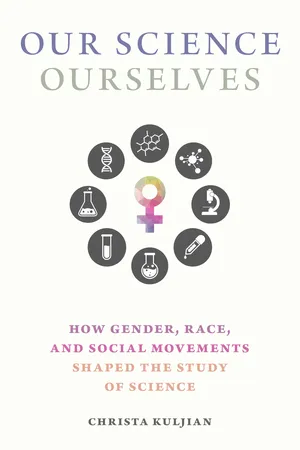
eBook - ePub
Our Science, Ourselves
How Gender, Race, and Social Movements Shaped the Study of Science
- 352 pages
- English
- ePUB (mobile friendly)
- Available on iOS & Android
eBook - ePub
Our Science, Ourselves
How Gender, Race, and Social Movements Shaped the Study of Science
About this book
Information
Publisher
University of Massachusetts PressYear
2024Print ISBN
9781625348180
9781625348197
eBook ISBN
9781685750893
Table of contents
- Cover
- Title Page
- Copyright Page
- Dedication
- Contents
- Illustrations
- Introduction
- Part One: Women In Science
- Part Two: Feminist Critiques Of Science, 1970 To 1990
- Part Three: Feminist Science Studies Coming Of Age, 1986 TO 2005
- Epilogue Feminist Science Studies Going Viral?
- Appendix 1 Where Are They Now?
- Appendix 2 Declaration: Equality for Women in Science
- Acknowledgments
- Notes
- Selected Bibliography
- Index
- Photo gallery
- Back Cover
Trusted by 375,005 students
Access to over 1.5 million titles for a fair monthly price.
Study more efficiently using our study tools.
Frequently asked questions
Yes, you can cancel anytime from the Subscription tab in your account settings on the Perlego website. Your subscription will stay active until the end of your current billing period. Learn how to cancel your subscription
No, books cannot be downloaded as external files, such as PDFs, for use outside of Perlego. However, you can download books within the Perlego app for offline reading on mobile or tablet. Learn how to download books offline
Perlego offers two plans: Essential and Complete
- Essential is ideal for learners and professionals who enjoy exploring a wide range of subjects. Access the Essential Library with 800,000+ trusted titles and best-sellers across business, personal growth, and the humanities. Includes unlimited reading time and Standard Read Aloud voice.
- Complete: Perfect for advanced learners and researchers needing full, unrestricted access. Unlock 1.5M+ books across hundreds of subjects, including academic and specialized titles. The Complete Plan also includes advanced features like Premium Read Aloud and Research Assistant.
We are an online textbook subscription service, where you can get access to an entire online library for less than the price of a single book per month. With over 1.5 million books across 990+ topics, we’ve got you covered! Learn about our mission
Look out for the read-aloud symbol on your next book to see if you can listen to it. The read-aloud tool reads text aloud for you, highlighting the text as it is being read. You can pause it, speed it up and slow it down. Learn more about Read Aloud
Yes! You can use the Perlego app on both iOS and Android devices to read anytime, anywhere — even offline. Perfect for commutes or when you’re on the go.
Please note we cannot support devices running on iOS 13 and Android 7 or earlier. Learn more about using the app
Please note we cannot support devices running on iOS 13 and Android 7 or earlier. Learn more about using the app
Yes, you can access Our Science, Ourselves by Christa Kuljian in PDF and/or ePUB format, as well as other popular books in History & Women in History. We have over 1.5 million books available in our catalogue for you to explore.