eBook - ePub
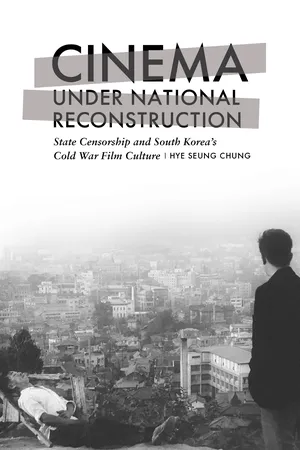
Cinema under National Reconstruction
State Censorship and South Korea’s Cold War Film Culture
- 251 pages
- English
- ePUB (mobile friendly)
- Available on iOS & Android
eBook - ePub
Cinema under National Reconstruction
State Censorship and South Korea’s Cold War Film Culture
About this book
Cinema under National Reconstruction calls for a revisionist understanding of state film censorship during successive Cold War military regimes in South Korea (1961–1988). Drawing upon primary documents from the Korean Film Archive's digitized database and framing South Korean film censorship from a transnational perspective, Hye Seung Chung makes the case that, while political oppression/repression existed inside and outside the film industry during this period, film censorship was not simply a tool for authoritarian dictatorship. Through such case studies as Yu Hyun-mok's The Stray Bullet (1961), Ha Kil-jong's The March of the Fools (1975), and Yi Chang-ho's Declaration of Fools (1983), the author defines censorship as a dialogical process of cultural negotiations wherein the state, the film industry, and the public fight out a battle over the definitions and functions of national cinema. In the context of Cold War Korea, one cannot fully understand or construct film history without reassessing censorship as a productive feedback system where both state regulators and filmmakers played active roles in shaping the new narrative or sentiment of the nation on the big screen.
Information
Publisher
Rutgers University PressYear
2024Print ISBN
9781978838710
9781978838727
eBook ISBN
9781978838734
Subtopic
Korean HistoryTable of contents
- Cover
- Title Page
- Copyright
- Dedication
- Contents
- Note on Text
- Chronology
- A List of Agencies and Acronyms
- Introduction: Archival Revisionism and New Korean Film Historiography
- 1. Fending off Darkness, Uplifting National Cinema: Korean Film Censorship and The Stray Bullet
- 2. From Blackboard Jungle to The Teahouse of the August Moon: Censoring Hollywood in Postcolonial Korea
- 3. Myths of Martyrs and Heroes in a Godless Land: Interagency Regulation of 1960s Anticommunist Films
- 4. Cinematic Censorship as Sentimental Education: Indoctrinating Gaiety as National Emotion in Yushin-Era Youth Comedies
- 5. Censors as Audiences and Vice Versa: Sex, Politics, and Labor in 1981
- 6. Beyond Oral Histories and Trade Legends: A Bourdieusian-Foucauldian Deconstruction of Anti-Censorship Myths
- Epilogue: Media Ratings, the End of Censorship?
- Acknowledgments
- Notes
- Index
- About the Author
Trusted by 375,005 students
Access to over 1.5 million titles for a fair monthly price.
Study more efficiently using our study tools.
Frequently asked questions
Yes, you can cancel anytime from the Subscription tab in your account settings on the Perlego website. Your subscription will stay active until the end of your current billing period. Learn how to cancel your subscription
No, books cannot be downloaded as external files, such as PDFs, for use outside of Perlego. However, you can download books within the Perlego app for offline reading on mobile or tablet. Learn how to download books offline
Perlego offers two plans: Essential and Complete
- Essential is ideal for learners and professionals who enjoy exploring a wide range of subjects. Access the Essential Library with 800,000+ trusted titles and best-sellers across business, personal growth, and the humanities. Includes unlimited reading time and Standard Read Aloud voice.
- Complete: Perfect for advanced learners and researchers needing full, unrestricted access. Unlock 1.5M+ books across hundreds of subjects, including academic and specialized titles. The Complete Plan also includes advanced features like Premium Read Aloud and Research Assistant.
We are an online textbook subscription service, where you can get access to an entire online library for less than the price of a single book per month. With over 1.5 million books across 990+ topics, we’ve got you covered! Learn about our mission
Look out for the read-aloud symbol on your next book to see if you can listen to it. The read-aloud tool reads text aloud for you, highlighting the text as it is being read. You can pause it, speed it up and slow it down. Learn more about Read Aloud
Yes! You can use the Perlego app on both iOS and Android devices to read anytime, anywhere — even offline. Perfect for commutes or when you’re on the go.
Please note we cannot support devices running on iOS 13 and Android 7 or earlier. Learn more about using the app
Please note we cannot support devices running on iOS 13 and Android 7 or earlier. Learn more about using the app
Yes, you can access Cinema under National Reconstruction by Hye Seung Chung in PDF and/or ePUB format, as well as other popular books in Media & Performing Arts & Korean History. We have over 1.5 million books available in our catalogue for you to explore.