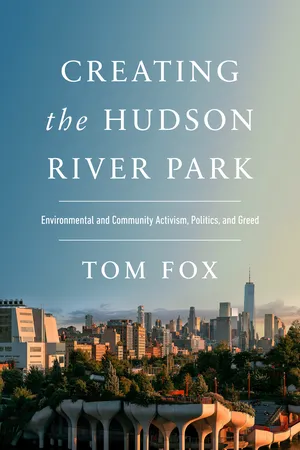
Creating the Hudson River Park
eBook - ePub

Creating the Hudson River Park

Environmental and Community Activism, Politics, and Greed

  1. 428 pages
  2. English
  3. ePUB (mobile friendly)
  4. Available on iOS & Android
eBook - ePub

Creating the Hudson River Park

Environmental and Community Activism, Politics, and Greed

About this book

The 4-mile-long, 550-acre Hudson River Park is nearing completion and is the largest park built in Manhattan since Central Park opened more than 150 years ago. It has transformed a derelict waterfront, protected the Hudson River estuary, preserved commercial maritime activities, created new recreational opportunities for millions of New Yorkers, enhanced tourism, stimulated redevelopment in adjacent neighborhoods, and set a precedent for waterfront redevelopment. The Park attracts seventeen million visitors annually. Creating the Hudson River Park is a first-person story of how this park came to be. Working together over three decades, community groups, civic and environmental organizations, labor, the real estate and business community, government agencies, and elected officials won a historic victory for environmental preservation, the use and enjoyment of the Hudson River, and urban redevelopment. However, the park is also the embodiment of a troubling trend toward the commercialization of America's public parks.

After the defeat of the $2.4 billion Westway plan to fill 234 acres of the Hudson in 1985, the stage was set for the revitalization of Manhattan's West Side waterfront. Between 1986 and 1998 the process focused on the basics like designing an appropriate roadway, removing noncompliant municipal and commercial activities from the waterfront, implementing temporary improvements, developing the Park's first revenue-producing commercial area at Chelsea Piers, completing the public planning and environmental review processes, and negotiating the 1998 Hudson River Park Act that officially created the Park. From 1999 to 2009 planning and construction were funded with public money and focused on creating active and passive recreation opportunities on the Tribeca, Greenwich Village, Chelsea, and Hell's Kitchen waterfronts.

However, initial recommendations to secure long term financial support for the Park from the increase in adjacent real estate values that resulted from the Park's creation were ignored. City and state politicians had other priorities and public funding for the Park dwindled. The recent phase of the project, from 2010 to 2021, focused on "development" both in and adjacent to the Park. Changes in leadership, and new challenges provide an opportunity to return to a transparent public planning process and complete the redevelopment of the waterfront for the remainder of the 21st-century. Fox's first-person perspective helps to document the history of the Hudson River Park, recognizes those who made it happen and those who made it difficult, and provides lessons that may help private citizens and public servants expand and protect the public parks and natural systems that are so critical to urban well-being. 


Trusted byΒ 375,005 students

Access to over 1.5 million titles for a fair monthly price.

Study more efficiently using our study tools.

Information

Year
2024
Print ISBN
9781978814011
eBook ISBN
9781978814028

Table of contents

  1. Cover
  2. Title Page
  3. Copyright
  4. Dedication
  5. Contents
  6. Preface
  7. Introduction
  8. 1. Starting the Journey
  9. 2. Westway (1974–1985)
  10. 3. The West Side Task Force (1986–1987)
  11. 4. The Letdown (1987–1988)
  12. 5. The West Side Waterfront Panel (1988–1990)
  13. 6. New Park Proposed (1990–1992)
  14. 7. Things Finally Start Happening (1992–1993)
  15. 8. Completing the Plan and Change at the Top (1994–1995)
  16. 9. A New Approach (1995–1997)
  17. 10. Hudson River Park Act (1998–2000)
  18. 11. The World Changes (2001–2003)
  19. 12. Hope Renewed, Problems Continue (2004–2008)
  20. 13. Going from Bad to Worse (2009–2012)
  21. 14. The Trust Goes over to the Dark Side (2013–2014)
  22. 15. Public Resistance Builds (2015–2016)
  23. 16. A Court Battle Ends, and the Governor Delivers (2016–2018)
  24. 17. Will the Incoming Tide Return? (2019–2023)
  25. 18. Hope Springs Eternal (2024 and Beyond)
  26. West Side Waterfront Transformation
  27. Acknowledgments
  28. Glossary
  29. Notes
  30. Index
  31. About the Author

Frequently asked questions

Yes, you can cancel anytime from the Subscription tab in your account settings on the Perlego website. Your subscription will stay active until the end of your current billing period. Learn how to cancel your subscription
No, books cannot be downloaded as external files, such as PDFs, for use outside of Perlego. However, you can download books within the Perlego app for offline reading on mobile or tablet. Learn how to download books offline
Perlego offers two plans: Essential and Complete
  • Essential is ideal for learners and professionals who enjoy exploring a wide range of subjects. Access the Essential Library with 800,000+ trusted titles and best-sellers across business, personal growth, and the humanities. Includes unlimited reading time and Standard Read Aloud voice.
  • Complete: Perfect for advanced learners and researchers needing full, unrestricted access. Unlock 1.5M+ books across hundreds of subjects, including academic and specialized titles. The Complete Plan also includes advanced features like Premium Read Aloud and Research Assistant.
Both plans are available with monthly, semester, or annual billing cycles.
We are an online textbook subscription service, where you can get access to an entire online library for less than the price of a single book per month. With over 1.5 million books across 990+ topics, we’ve got you covered! Learn about our mission
Look out for the read-aloud symbol on your next book to see if you can listen to it. The read-aloud tool reads text aloud for you, highlighting the text as it is being read. You can pause it, speed it up and slow it down. Learn more about Read Aloud
Yes! You can use the Perlego app on both iOS and Android devices to read anytime, anywhere β€” even offline. Perfect for commutes or when you’re on the go.
Please note we cannot support devices running on iOS 13 and Android 7 or earlier. Learn more about using the app
Yes, you can access Creating the Hudson River Park by Tom Fox in PDF and/or ePUB format, as well as other popular books in Architecture & Architecture General. We have over 1.5 million books available in our catalogue for you to explore.