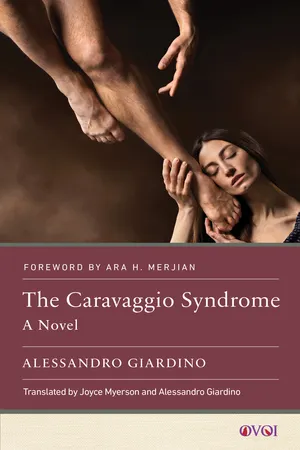
Leyla is a headstrong Brooklyn-born art historian at a prestigious upstate New York college. When she meets feckless young computer technician Pablo at a party, she quickly becomes pregnant with his child. There's only one problem: she can't stand him. And one more problem: her student Michael wants Pablo for himself.
Amid this love triangle, the objects of Leyla and Michael's study take on a life of their own. Trying to learn more about Caravaggio's masterpiece The Seven Works of Mercy, they pore over the journal and prison writings of maverick 17th-century utopian philosopher Tommaso Campanella, which, as if by enchantment, transport them back four centuries to Naples. And while the past and present miraculously converge, Leyla, Michael, and Tommaso embark on a voyage of self-discovery in search of a new life.
In this fusion of historical, queer, and speculative fiction, Alessandro Giardino combines the intellectual playfulness of Umberto Eco with the psychological finesse of Michael Cunningham.
- 210 pages
- English
- ePUB (mobile friendly)
- Available on iOS & Android
eBook - ePub
About this book
Information
Publisher
Rutgers University PressYear
2024Print ISBN
9781978839496
9781978839502
eBook ISBN
9781978839519
Table of contents
- Cover
- Praise for The Caravaggio Syndrome
- Series Page
- Title Page
- Copyright
- Epigraph
- Contents
- List of Illustrations
- Foreword: Caravaggio, Convergences, Craquelure
- Translator’s Note
- Author’s Note
- Preface
- Prologue: Tommaso Campanella
- Part 1
- Part 2
- Part 3
- Part 4
- Epilogue
- Notes on Contributors
Trusted by 375,005 students
Access to over 1.5 million titles for a fair monthly price.
Study more efficiently using our study tools.
Frequently asked questions
Yes, you can cancel anytime from the Subscription tab in your account settings on the Perlego website. Your subscription will stay active until the end of your current billing period. Learn how to cancel your subscription
No, books cannot be downloaded as external files, such as PDFs, for use outside of Perlego. However, you can download books within the Perlego app for offline reading on mobile or tablet. Learn how to download books offline
Perlego offers two plans: Essential and Complete
- Essential is ideal for learners and professionals who enjoy exploring a wide range of subjects. Access the Essential Library with 800,000+ trusted titles and best-sellers across business, personal growth, and the humanities. Includes unlimited reading time and Standard Read Aloud voice.
- Complete: Perfect for advanced learners and researchers needing full, unrestricted access. Unlock 1.5M+ books across hundreds of subjects, including academic and specialized titles. The Complete Plan also includes advanced features like Premium Read Aloud and Research Assistant.
We are an online textbook subscription service, where you can get access to an entire online library for less than the price of a single book per month. With over 1.5 million books across 990+ topics, we’ve got you covered! Learn about our mission
Look out for the read-aloud symbol on your next book to see if you can listen to it. The read-aloud tool reads text aloud for you, highlighting the text as it is being read. You can pause it, speed it up and slow it down. Learn more about Read Aloud
Yes! You can use the Perlego app on both iOS and Android devices to read anytime, anywhere — even offline. Perfect for commutes or when you’re on the go.
Please note we cannot support devices running on iOS 13 and Android 7 or earlier. Learn more about using the app
Please note we cannot support devices running on iOS 13 and Android 7 or earlier. Learn more about using the app
Yes, you can access The Caravaggio Syndrome by Alessandro Giardino, Joyce Myerson,Alessandro Giardino in PDF and/or ePUB format, as well as other popular books in Literature & Literature General. We have over 1.5 million books available in our catalogue for you to explore.